Directed Graphs
This article delves into the fundamentals of directed graphs, also known as digraphs, exploring their structure and key concepts like vertices and directed edges. It discusses walks and paths, highlighting definitions such as the shortest path and cycles, and provides proofs for various lemmas. Moreover, it introduces the concept of Directed Acyclic Graphs (DAGs) and their applications, such as unique team rankings in tournament graphs. Ideal for computer scientists and students, this resource outlines important terms and relationships in the study of graphs.


Directed Graphs
E N D
Presentation Transcript
Normal Person’s Graph y = f(x) y x
Computer Scientist’s Graph b a c d f e
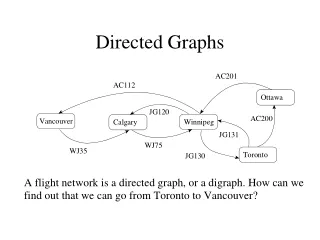
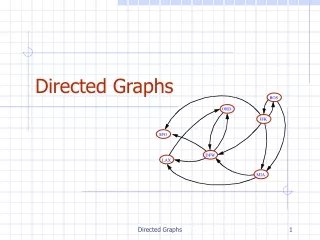
Digraphs • a set, V, of vertices aka “nodes” • a set, E⊆V×V of directed edges (v,w)∈ E • notation: v→w v w
Relations and Graphs a b d c V= {a,b,c,d} E = {(a,b), (a,c), (c,b)}
Digraphs Formally, a digraph with vertices V is the same as a binary relation on V.
Walks & Paths Walk: follow successive edges length: 5 edges (not the 6 vertices)
Walks & Paths Path: walk thru vertices without repeat vertex length: 4 edges
Walks & Paths Lemma: The shortest walk between two vertices is a path! Proof:(by contradiction) suppose path from u to vcrossed itself: c v u
Walks & Paths Lemma: The shortest walk between two vertices is a path! Proof:(by contradiction) suppose path from u to vcrossed itself: then path without c---cis shorter! c v u
Walks & Paths Digraph G defines walk relation G+ u G+viff∃walk u to v (the positive walk relation) “+” means 1 or more
Walks & Paths Digraph G defines walk relation G* u G*viffu to v (the walk relation) “*” means “0 or more”
Cycles A cycle is a walk whose only repeat vertex is its start & end. (a single vertex is a length 0 cycle)
… v0 v1 v2 vn-1 v0 Cycles vi vi+1 v0
Closed Walks & Cycles Closed walk starts & ends at the same vertex. Lemma:The shortest positive length closed walk containing a vertex is a positive length cycle! Proof: similar
Directed Acyclic Graph DAG has no positive length cycle lec 7M.16
Directed Acyclic Graph DAG examples: < relation on integers ⊊ relation on sets prerequisite on classes
Example: Tournament Graph H H Y Y P P D D DAG => Unique ranking Every team plays every other