Integrated Schema Matching for Oracle Databases at RIT
120 likes | 158 Vues
Explore the importance of schema matching for data integration, detailing syntactical and elemental approaches, hypothesis, objectives, and algorithms for effective matching techniques at Rochester Institute of Technology.


Integrated Schema Matching for Oracle Databases at RIT
E N D
Presentation Transcript
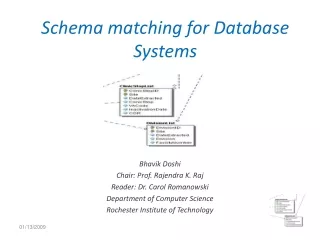
Schema matching for Database Systems Bhavik Doshi Chair: Prof. Rajendra K. Raj Reader: Dr. Carol Romanowski Department of Computer Science Rochester Institute of Technology
EMPID Name Salary EMPID Name Salary has Employee Position-type Employee SSN Position SSN Position Schema Matching • Given: Source and Target schemas • Matching: Maps the source schema elements to target schema elements.
Why Schema Matching? • First step of Data Integration • Upcoming field in Data management research because of its important role in Enterprise Information Integration. • Building data warehouses and marts • Manual approach is very laborious
Syntactical Approach • Uses Syntax used for naming databases Elemental Level Approach ? Random Names
Data value and Constraint based approach • Uses data values, data types, comparison of ranges. Instance based approach ? Data values not appropriate
Hypothesis • Relying on a single technique for schema matching may not always succeed. • Each approach is implemented independently of the others and so the overall impact is not as effective. • Develop an integrated technique which is domain independent for oracle databases.
Objective • Develop a generic integrated matching technique. • Implement two substantially different techniques • Kang et al. • Lingmei et al. • Transform steps of the above two algorithms and make use of additional techniques for better matching. • Testing the developed technique with (~30) relational datasets and then observing the results.
Algorithms • Instance Based schema matching • Kang et al. • Element Level schema matching • Lingmei et al.
Route to Success!! Probability Distribution Syntax Semantics Structure Kang’s Approach Lingmei’s Approach Instance Based Element Based Data Type and Range Integrated Approach