Download
1 / 1
10 likes | 122 Vues
Delve into how learners communicate in classrooms through intercultural dialogue. Learn methodologies for assessing intercultural competence and linguistic diversity in education. Identify the hidden indigenous and theoretical knowledge that influences teaching practices. Explore the role of students as teachers in fostering dialogue and understanding.

E N D
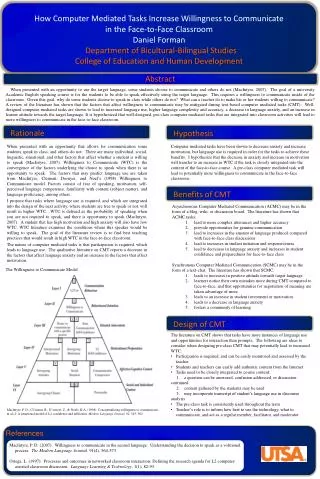
Curriculum and pedagogy: Preliminary questions - How do learners communicate in the classroom? Talk/tasks/assignments What is intercultural dialogue? multi/trans/inter/cultural… To what extent is dialogue authentic? (What does this mean?) How is this planned for? Curriculum/syllabus/lesson What is intercultural learning? multi/trans/inter/cultural… How is this planned for? Curriculum/syllabus/lesson How do international students communicate in comparison with national/mono-lingual? (Is this a useful comparison? Are there any distinct patterns?) What methodologies and tools for evaluating the status quo? For forward planning? What is intercultural competence? How do teachers in HE assess and evaluate intercultural competence/competencies? Pedagogy for IoC Dialogue Vs. discipline: What are the languages of praxis? What are their local variants? Terminologies: What might be lost in translation? How does language work in its local context and setting? Areas of knowledge that lie hidden (e.g. traditional healing)Indigenous knowledges (e.g Roma)Theoretical and conceptual terms of practice (‘inclusion’, ‘disability’)Linguistic diversity/ homogeneity within a discipline or industry (pharma, fashion; language economically constructed)ICT: A disciplinary lingua franca?‘Research’: A universally contested term!Protein nature of language; mutability, malleabilityNo fixed forms, no absolutesStudents as ‘resourceful peers’. Student as teacher