Understanding Censorship in China: Impact on Freedom of Speech and Information Flow
100 likes | 226 Vues
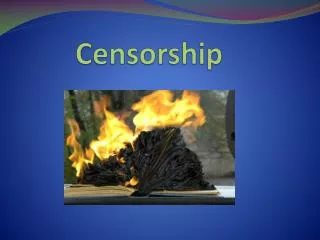
Censorship in China is a pervasive issue that suppresses speech and public communication deemed objectionable. Governed by strict state control, this censorship restricts access to information on sensitive topics, including the Tiananmen Square protests of 1989 and the independence movements of various ethnic groups. As a result, media outlets commonly engage in self-censorship to avoid backlash, leading to a distortion of truth similar to propaganda. This reality severely affects the freedom of the press and the dissemination of information, ranking China among the worst in global press freedom.


Understanding Censorship in China: Impact on Freedom of Speech and Information Flow
E N D
Presentation Transcript
What is Censorship? • Censorship is the suppression of speech or other public communication which may be considered objectionable, harmful, sensitive, politically incorrect or inconvenient as determined by a government, media outlet or other controlling body. Source: Wikipedia
Difference between censorship and propaganda? • Censorship = restriction of information • Propaganda = promotion of information Both distort the ‘truth’.
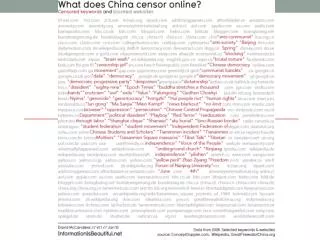
Censored topics • Democracy • Tiananmen Square protests of 1989 • Maoism • Falun Gong • Uighur or Tibetan Independence Movement • Corruption • Police Brutality • Anarchism • Disparity of Wealth • Pornography • etc…
Rankings • Reporters without borders ranks China’s press situation as “very serious” (the worst on their 5 point scale) • OpenNet rates the restrictions as “pervasive” (again, worst on scale) • Freedom House ranks the press as “not free” “State control over the news media in China is achieved through a complex combination of party monitoring of news content, legal restrictions on journalists, and financial incentives for self-censorship” – Freedom House
Bloomberg / NY Times • 2013 Bloomberg allegedly censors news stories regarding corruption in China. In the call late last month, Mr. Winkler defended his decision, comparing it to the self-censorship by foreign news bureaus trying to preserve their ability to report inside Nazi-era Germany, according to Bloomberg employees familiar with the discussion. “He said, ‘If we run the story, we’ll be kicked out of China,’ ” one of the employees said. Less than a week later, a second article, about the children of senior Chinese officials employed by foreign banks, was also declared dead, employees said. http://www.nytimes.com/2013/11/09/world/asia/bloomberg-news-is-said-to-curb-articles-that-might-anger-china.html?pagewanted=all&_r=0