Download
1 / 19
190 likes | 312 Vues
Dive into the fascinating world of mitosis, the process of asexual reproduction where somatic cells divide to form two new nuclei, maintaining identical chromosomes. Learn about the five stages of the cell cycle - Interphase, Prophase, Metaphase, Anaphase, and Telophase - each crucial for successful cell division. Explore the role of chromosomes and how they are organized within the cell. Understand why mitosis is essential for growth, repair, and replacement in living organisms. Plus, discover the implications of uncontrolled mitosis in cancer.

E N D
I. Mitosis Happy Halloween!
A. Asexual Reproduction • When do cells use it? • Growth • Repair • Replacement • Cell that reproduce by asexual reproduction reproduce constantly.
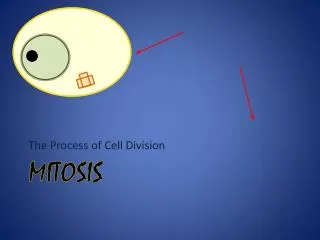
B. Mitosis = Asexual Reproduction • Division of somatic cells (body) • Process in which the nucleus divides to form 2 new nuclei Daughter Cells Somatic Cell Performed by a single (parent) cell
C. PURPOSE OF MITOSIS: 1. TO PRODUCE TWO NEW NUCLEI WITH… a. EXACTLY THE SAME KIND OF CHROMOSOMES b. EXACTLY THE SAME NUMBER OF CHROMOSOMES.
D. What are Chromosomes? • Organized structure of DNA in the cell • Located in the nucleus • Usually are uncoiled in the form of chromatin • Only visible when the cell divides and the chromatin condenses • Held together by a centromere
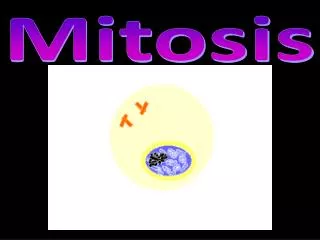
E. 5 Stages of the Cell Cycle (do not write) Interphase Prophase Metaphase Anaphase Telophase **Animated Video**
1. Interphase • Prior & After Mitosis • G1 period • 90% of cell life spent here • Cell goes about it’s business • S period • DNA is duplicated • G2 period • Cell prepares to divide • Cannot see DNA- uncoiled as chromatin
2. Prophase • DNA becomes visible as chromosomes • Nuclear membrane dissolves • Centrioles migrate to opposite poles • Spindle fibers form Easy to remember- Prophase- prepares for mitosis
3. Metaphase • Spindle fibers attach to centromeres • Chromosomes line up at midline of the cell Pole Spindle Equator Pole Easy to remember- metaphase, DNA at middle
4. Anaphase • Spindle fibers pull apart centromeres • One chromatid goes to each centriole (they look like V’s) Easy to remember- anaphase, away they go
5. Telophase • Chromatids reach centrioles • Mitosis ends when new nuclear membranes form • Some evidence of cell dividing Easy to remember- telophase, terminal phase
6. Last part- Cytokinesis • Division of Cytoplasm • Technically not in mitosis • Animal cell- pinching of cell membrane- cleavage • Plant cell- formation of new cell wall- cell plate • DNA becomes non-visible, back to chromatin • Daughter cells enter G1 period of interphase
What Kind of Cells Does Mitosis Produce? • Cells with a complete set of chromosomes called diploids • Humans have 46 chromosomes or 23 pairs of chromosomes • Human diploid # = 23 • Most cells are diploid
Cancer • Uncontrollable mitosis (no G1) • Cells cease to do what they are supposed to be doing in favor of dividing. • Cancer does not “poison” your body…
Henrietta Lacks • 1951, a poor 31 Year old African American mother of 4 was dying of cervical cancer @ Johns Hopkins Hospital • Dr. George Gey- sampled some of the cancerous cells, found they could live indefinitely and multiply outside the body • She died 6 months later, but cells still live on • HeLa cells • Used to study many different diseases • Polio Vaccine • How to transport cells
The Mitosis Shuffle! • First, lets watch: University of Madison Mitosis Shuffle • Your turn! “The Hustle” by Van McCoy
Homework • Mitosis Booklet • 3 pgs • 5 phases • 6 colors (one per chromosome)