Download
1 / 1
10 likes | 111 Vues
This study examines the social-ecological systems of North Pacific coastal communities facing climate change impacts. Applying quantitative responses and adaptive management policies, it aims to enhance resilience, decrease risks, and increase sustainability through innovative strategies. The research focuses on key factors such as trophic interactions, fisheries, and community adaptation, highlighting the need for both bottom-up and top-down approaches to foster resilience.

E N D
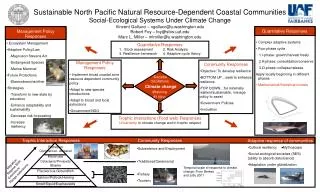
Sustainable North Pacific Natural Resource-Dependent Coastal CommunitiesSocial-Ecological Systems Under Climate ChangeVincent Gallucci – vgallucc@u.washington.eduRobert Foy – foy@sfos.uaf.eduMarc L. Miller – mlmiller@u.washington.edu Uw logo • Quantitative Responses • Complex adaptive systems • Four phase cycle • r-phase: growth/harvest freely • K-phase: consolidation/conserve • Ω-phase: collapse/release • Apply locally beginning in different phases • Mathematical/Statistical models • Management Policy Responses • Ecosystem Management • Adaptive Policy/Law • -Magnuson Stevens Act • -Endangered Species • -Marine Mammal • Future Protections • -Elasmobranchs/other • Strategies • -Transform to new state by education • -Enhance adaptability and sustainability • -Decrease risk forecasting • -Increase resiliency Quantitative Responses 1. Stock assessment 2. Risk Analysis 3. Resilience framework 4. Adaptive cycle theory • Management Policy Responses • Implement broad coastal zone resource dependent community policy • Adapt to new species introductions • Adapt to broad and local extinctions • Government/NGO • Community Responses • Objective: To develop resilience • BOTTOM UP…seek to enhance resilience • TOP DOWN…for minimally resilient/sustainable, manage policy to assist • Government Policies • Innovation • DecadalOscillations Climate change • Warming • El Nino Trophic Interactions (Food web) Responses Uncertainty in climate change and in trophic respect Trophic Interaction Responses Community Responses • Adaptive response of communities • Cultural resiliency Mythoscape • Social-ecological societies (SES) (ability to absorb disturbance) • Adaptation under globalization FisheriesCommercial - Artisanal Mammals Cetaceans/Pinnipeds Sharks Piscivorous Groundfish Salmon/Pollock/Herring Smelt/Squid/Euphausiids • Subsistence and Employment • Traditional/Ceremonial • Fishery • Tourism Migration Regime Shift ExtinctionsRange extensions Temporal scale of response to climate change: From Berkes and Jolly 2001