Effective Incident Management for Illinois Tollway Safety and Traffic Flow
370 likes | 503 Vues
The Illinois Tollway has evolved since its opening in 1958, growing from 187 miles and 62,000 daily vehicles to 286 miles serving 1.4 million vehicles by 2010. With a robust incident management system, it enhances highway safety, reduces congestion, and minimizes environmental impacts. Key components include rapid notification, real-time monitoring through TIMS, and coordinated response teams. Maintenance personnel are trained as first responders, utilizing various communication channels to ensure public awareness and expedite lane clearance, with an average incident response time of just 34 minutes.


Effective Incident Management for Illinois Tollway Safety and Traffic Flow
E N D
Presentation Transcript
The Illinois Tollway - 1958 • The Tollway opens in 1958 • 187 miles, serving 62,000 vehicles a day • 8 maintenance sections • 265 bridge structures • 9 mainline toll plazas • 15 ramp toll plazas
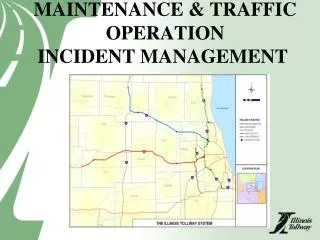
The Illinois Tollway - 2010 • The Tollway in 2010 • 286 miles, serving 1.4 million vehicles a day • 2,035 lane miles • 11 maintenance sections • 636 bridge structures • 22 mainline toll plazas • 51 ramp toll plazas
SYSTEM - WIDE AVERAGE DAILY TRAVEL I90 – 301,750 Tri – 593,250 I88 – 260,970 N/S - 205,210
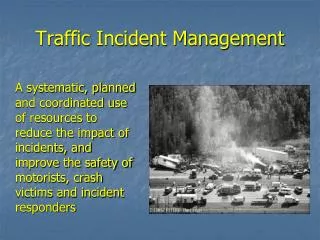
Rule of Thumb • Every minute of lane blockage on the road can create from four to nine minutes of resulting congestion.
Reasons for Incident Management • It improves highway safety • It reduces traffic congestion • It reduces emissions and enhances environmental conditions
Keys to Incident Management • Notification • Detection • Confirmation • Communication • Response • Site management • Clearance
Notification • Motorist report to Tollway via cell phone • Internal report via State Police or Maintenance • Media report • #999 Cellular Express Line • TIMS (Traffic Incident Management Center) • CCTV surveillance observes incident • All notifications go through Computer-Aided Dispatch Center (CAD)
TRAFFIC OPERATIONS • TRAFFIC OPERATIONS CENTER – TIMS • 5A-8P Mon/Fri (weekends as needed) • 4 console workstations • 4 TIMS Computers • 4 CAD computers • 6 video wall units • Media hotlines/email notifications • Tollway LAN
Traffic Operations Cont’d. • TIMS Responsibilities • Incident detection, confirmation, assessment • Monitor and report effects of construction on traffic • Communicate to the public • Media, DMS, PCMS • Regional communications
Communication • Motorist - Customer • Through 39 DMS on system • Through 49 PCMS • Through the GCM web page • E-mails to media, radio, and TV • Cross agency messaging
Response • 11 maintenance locations throughout system • Responsible for 25 to 30 center line miles • From 25 to 44 full-time personnel • 7 located in Chicago; 4 located in rural areas • 24 x 7 operation routine maintenance & incident response • Significant resource base
Response (cont.) • All maintenance personnel trained in traffic control and as a first responders • ISP District 15 assigned to Illinois Tollway • 60 arrow-board response units • 55 fire and ambulance agreements
Response (cont.) • 36 towing and service agreements • 7Vehicle recovery agreements • Hazardous materials contracts
Site ManagementTraffic Control • Not to be restrictive • Be aware of the needs of others • Analyze what is needed and how to establish traffic flow • Protect the scene for all responders for duration of operations • Minimize lane blockage and mitigate congestion
Primary Focus Is On Safety • Protecting the responders • Attending to the injured • Safe travel through the scene
On Scene Traffic Control • Inherent danger while working adjacent to live traffic • Need to establish a safe working area • Provide a temporary work zone
Clearance • Restore traffic flow • Safely move traffic around incident • Re-open lanes without delay • Average, 219,000 incidents • Average clear time 34 minutes
Communication Coordination Cooperation Three “Cs” for a Traffic Incident
Communication • I-REACH (Illinois Radio Emergency Assistance Channel) • Various agencies can communicate together • It is a tool for assisting and locating incidents • Interactions at the scene • Post incident review • Mutual field visits to facilities
I-REACH RADIO • This practice is used for emergency response communications for incidents that occur on the Tollway system • Complies with the operational concepts provided under and in support of the: • National Incident Management System (NIMS) • Unified Command System (UCS) • Incident Command System Principles (ICS)
Coordination • Set-up unified command • Identify the leaders; meet face to face • Assess resources needed and available • Determines staging areas for ancillary equipment • Allow time and opportunity to get the job done • Determine efficient exit strategy mitigate the impact
Cooperation • Take a team approach to incident resolution • Be aware of the needs of others • Maximize safety of the responders • Maximize the efficiency of operations • Provide highest level of service to our customers
Questions? Steve Musser Smusser@GETIPASS.COM IllinoisTollway.com (630) 241-6800, extension 3904