Understanding Nuclear Stability: Nucleons, Radioactivity, and Atomic Transformations
This chapter delves into the fundamentals of nuclear chemistry, focusing on nucleons such as protons and neutrons, and their role in nuclear stability. It covers key concepts like nuclides, isotopes, isobars, and the forces that bind nucleons together. The chapter discusses various types of nuclear changes including spontaneous decay, fission, fusion, and transmutation. Additionally, practical applications such as radioactive dating, smoke detectors, and neutron analysis highlight the significance of nuclear chemistry in real-world scenarios.

Understanding Nuclear Stability: Nucleons, Radioactivity, and Atomic Transformations
E N D
Presentation Transcript
NuclearChemistry Ch.18
(18-1) Nuclear Stability • Nucleons: p+ & n0 • Nuclide: any combo of p+ & n0 in a nucleus • Isotope: same at.#, but different mass • Te-122, Te-124, Te-128 • Isobar: same mass, but different at.# • Xe-124, Te-124, Sn-124
Binding Forces • Strong nuclear force: attraction that holds nuclear particles together • Overcomes repulsive forces
Mass Defect • Mass converted to E when a nucleus forms
Nuclear Binding E • E emitted when nucleons come together (E needed to break a nucleus apart)
Band of Stability • Area on a graph of n0 # v. p+ # in which all stable nuclei lie
Nuclei are more stable if they… • Contain n0 ≥ p+ • Do not have too many or too few n0 • Have even #’s of nucleons • Have “magic #’s” of p+ or n0 • 2, 8, 20, 28, 50, 82, 126 • Are not a neighboring isobar
(18-2) Types of Nuclear Change • Spontaneous • Radioactivity • Artificial Transmutations 2. Fission 3. Fusion • Nonspontaneous 4. Transmutation
Radioactivity • A nucleus decays & emits particles & electromagnetic waves
Converting n0 to p+ • Beta (β) decay: nuclei w/ too many n0 for the at.# become more stable by decaying & emitting radiation • β particle: e- emitted from a nucleus when a n0 changes to a p+ • Ex:
Converting p+ to n0 • e- capture: nucleus has too few n0, so it absorbs an e-, which changes a p+ into a n0 • Gamma rays (γ): E produced by decaying nuclei • Ex:
Converting p+ to n0 (cont.) • Positron emission: nuclei emit postitrons (antiparticles of e-) • Ex:
Annihilation of Matter • Event when a particle collides w/ its anitparticle & both are changed into E
Losing Alpha Particles • Alpha (α) decay: very large nuclei w/ too few n0 can decay by emitting α particles • α particles: Helium-4 made when a n0 decays • Ex: • Decay series: many heavy nuclei must decay several times before reaching a stable state
Balancing Nuclear Eq.’s • Total mass #’s & nuclear charges must balance on both sides of the eq. • Ex: Masses = 234, Charges = 90 • Ex: Masses = 238, Charges = 92
Nuclear Fission • Rxn in which a large nucleus splits into 2 & produces a lot of E • Chain rxn: nuclear rxn that sustains itself • Critical mass: smallest mass of radioactive material needed to sustain a chain rxn
Nuclear Fusion • 2 small nuclei combine to form 1 more stable nucleus & lots of E • Reactants are plasmas (mixture of + nuclei & e-) • Need very high T’s & P’s
Transmutation • Creating new nuclei by bombarding a nucleus w/ α particles • Produces an unstable cmpd that stabilizes by emitting a p+
(18-3) How Nuclear Chem is Used • Radioactive dating: using radioactive isotopes to determine an object’s age • Half-life: time required for half of a radioactive material to decay
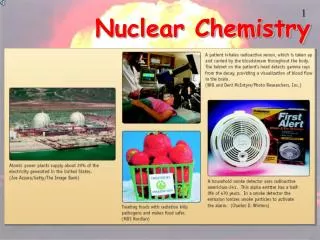
Smoke Detectors • Have an α emitter, which attract e- from the gas, changing them to ions which conduct electricity • When smoke particles mix w/ the gas, they reduce current flow & the detector’s circuits are set off
Neutron Analysis • Used to determine composition of objects • Meteorite composition • Forensic science (gun residue)
Radiation Exposure • rem: biological effect of exposure to nuclear radiation • Limit of 5 rems/yr