Unit 1 Outline
Unit 1 Outline. Meera Keshav , Hannah Bell, Kathryn Brandos , Brianna Bockman. Cells:. Shrink/crenate in hypertonic solution Water leaves cell Swell, can lyse in hypotonic solution Water enters cell Remains the same in isotonic solution Water enters and leaves cell at same rate.


Unit 1 Outline
E N D
Presentation Transcript
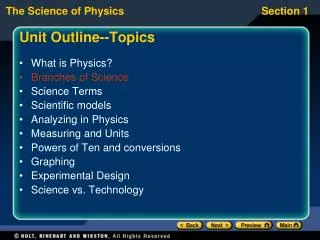
Unit 1 Outline MeeraKeshav, Hannah Bell, Kathryn Brandos, Brianna Bockman
Cells: • Shrink/crenate in hypertonic solution • Water leaves cell • Swell, can lyse in hypotonic solution • Water enters cell • Remains the same in isotonic solution • Water enters and leaves cell at same rate
Macromolecules • Carbohydrates • Lipids • Proteins • Nucleic acids
Carbohydrates • Made up of sugars for energy and structure • Monosaccharides for quick energy • Dissacharides for short storage • Polysachharides for long storage and forming structures • Glycogen, cellulose, chitin
Lipids: • Triglycerides: fats and oils • Phospholipids: primary component of cell membrane • Steroids: cell signaling. Can pass trhough lipid membranes. • Waxes: Protection and prevents water loss.
Proteins: • The building blocks of proteins are 20 types of Amino Acids. • Amino acids join together to form peptides, polypeptides, and polypeptide chains. • Structural proteins and enzymes.
Nucleic Acids: • Nucleortides: building blocks of nucleic acids. Contains a phosphate, a nitrogenous base and a 5-carbon sugar. • DNA, RNA, and ATP.
Blood pH • pHbelow 7: acid. • pHabove 7: base • pH=7: amphoteric (neutral) • Buffers resist pH changes. • More carbon dioxide in the blood equals more acid=lower pH • Blood pH= 7.35 • Acidosis= pH below 7.35 • Depresses the nervous system • Coma state • Alkalosis= pH above 7.45 • Overexcites the nervous system • Convulsions of the body
Levels of Organization: Atom – hydrogen atom, lithium atom Molecule – water molecule, glucose molecule Macromolecule – protein molecule, DNA molecule Organelle – mitochondrion, Golgi apparatus Cell – muscle cell, nerve cell Tissue – loose connective tissue, muscle tissue Organ – skin, femur Organ System – skeletal system, digestive system Organism - human
Homeostasis • The body’s maintenance of a stable environment • Homeostatic Mechanisms: the factors that control the different aspects of the environment and corrects the changes: • Receptors - provide information • Control center - tells what a particular value should be • Effectors - causes responses to change internal environment
Anatomical Terminology • Anatomical Position – body standing erect, facing forward, upper limbs at the sides, palms facing forward • Terms of Relative Position • Superior versus Inferior • Anterior versus Posterior • Medial versus Lateral • Proximal versus Distal • Superficial versus Deep
Body sections • Sagittal/midsagittal • Transverse(cross) • Coronal(frontal) • oblique