Download
1 / 13
140 likes | 290 Vues
Explore the dramatic events surrounding the assassination of President John F. Kennedy on November 22, 1963. This presentation covers the assassination timeline, including the shooting, the actions of Lee Harvey Oswald, and his subsequent arrest. We’ll analyze the findings of various investigations, including the Warren Commission and the HSCA, and the controversies surrounding them. Additional context includes international events like the 1956 Warsaw Pact and the impact of the Cold War. Join us to uncover what you missed about this pivotal moment in American history.

E N D
MISSED CLASS? Ask me what you missed and/or for handouts.
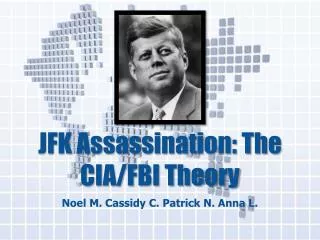
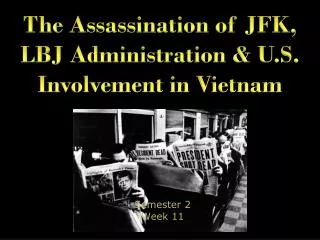
Friday Nov. 22, 1963, 12:30pm • Dallas, Texas • 3 shots • JFK shot in the head, dead on arrival to the hospital • Connelly shot multiple times • James Tague injured by a bullet fragment
Lee Harvey Oswald • Oswald reported missing by his supervisor at the Depository. • Arrested 70 min. after assassination for killing a police officer, Officer Tippit.
Tippit was going to arrest him based on a description of the suspect. • Oswald arrested sneaking in a movie theatre without a ticket. • He claimed innocence. Oswald tried to explain the evidence but ended up lying. • Shot by Jack Ruby, a Dallas night club owner.
The gun • Carcano M91/38 bolt action rifle • Found on floor of depository • Bought by Oswald under an alias “A. Hidell” • Palm print and fibers found on the gun a match to Oswald. • Bullet found on Connelly’s hospital gurney.
Autopsy files • Autopsy at Bethesda Naval hospital • Present at the autopsy: secret service agents, medical professionals • United States President's Commission on CIA activities within the United States (President Ford) aka. Rockefeller Commission • Document inventory analysis: Assassination Records Review Board (1992–98)
Warren Commission (1963-1964): Lee Harvey Oswald assassinated JFK. Jack Ruby killed Oswald. • United States House Select Committee on Assassinations (HSCA): CIA and Warren Commission reports were flawed • So who did it? UNKNOWN.
Poland 1956 • Strikers demanding more freedom • Wladyslaw Gomulka in power • Decollectiviation • Lifted restrictions on the Church
Hungarian Rising 1956 • Public wanted Rakosi removed • Imre Nagy: went with public opinion • Pulling out of Warsaw Pact • Nov. 4, 1956: Soviet tanks. 30,000 killed • Janos Kadar installed
Prague Spring • Alexander Dubcek replaced his more Stalinist predecessor • Wanted to give more freedoms • Troops moved in with little resistance • Replaced with Husak • Czechs didn’t want to break out. Only wanted to reform communism. • Brezhnev Doctrine: Freedom dominoes
Nuclear Proliferation • Mutually assured destruction • Deterrence • Peaceniks: non-proliferation • Military spending allocated to nuclear research • Military industrial complex • Pre-emptive strike • Winnability • ICBM (Inter-Continental Ballistic Missle)
Treaties • States need to sign and ratify it through parliament • Partial Nuclear Test Ban Treaty 1963 • Nuclear Non-Proliferation Treaty 1968 • Biological Weapons Convention 1972 • Chemical Weapons Convention 1993 • Comprehensive Nuclear-Test-Ban Treaty (CTBT) 1996 – still not entered into force