Scintag -2 Diffractometer
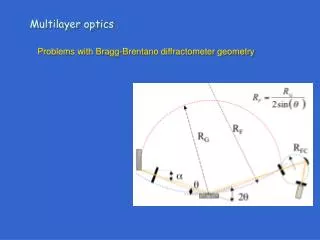
This document presents the X-ray diffraction data collected from a Ba-Titanate sample using a Scintag diffractometer. The experiment focused on the geometry and method of data collection, with a clear indication of the sample description and relevant parameters such as start time, wavelength, and scan rate. The analysis employs Jade's Figure of Merit (FOM) algorithm to evaluate the quality of the diffraction pattern, assessing the match likelihood based on the percentage of reference and unknown lines that align, providing a rigorous framework for data interpretation.
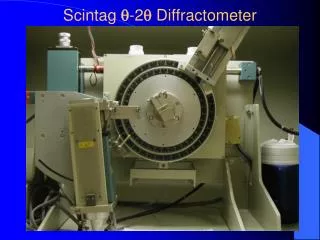

Scintag -2 Diffractometer
E N D
Presentation Transcript
MDI X-Ray Data File Format Data file format Date Start time Sample description 08-09-99 @12:21 DIF BTO113990702A Ba-Titanate (TPL-Luther) 10.0 0.02 -2.0 CU 1.54056 70.0 3001 43 47 42 45 43 31 42 45 37 38 33 51 37 47 46 40 51 36 36 34 31 46 48 37 45 54 45 29 37 42 39 40 Total # data points Scan rate deg/min Starting 2 Ending 2 Anode First 32 (of 3001) data points Wavelength of anode Step size or “chopper increment” in 2
The Figure of Merit (FOM) Jade’s FOM algorithm is not exactly known, but is unusual in that the lower the FOM value, the higher the likelihood of a match. Jenkins and Snyder (1996) use the following formula to calculate a FOM: where: dR is the percentage of reference lines that match the unknown; IR is the percentage of the reference intensity matched; dU is the percentage of unknown lines matched. In this formulation, the FOM is scaled from 0 to 100, with 100 being a perfect match.