Download
1 / 2
20 likes | 137 Vues
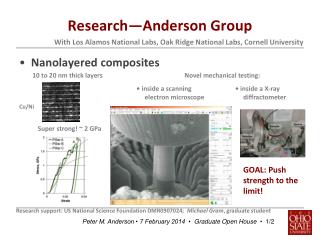
This research, conducted by the Anderson Group in collaboration with Los Alamos and Oak Ridge National Laboratories, focuses on developing nanolayered composites with layers as thin as 10 to 20 nm, achieving remarkable strength of ~2 GPa through advanced mechanical testing within scanning electron microscopes and X-ray diffractometers. Additionally, the team explores alternatives to Fe-based alloys for nuclear plant valves, seeking galling-resistant materials devoid of cobalt while ensuring excellent wear properties. The project is supported by the US National Science Foundation.

E N D
Research—Anderson Group With Los Alamos National Labs, Oak Ridge National Labs, Cornell University • Nanolayered composites 10 to 20 nm thick layers Novel mechanical testing: • inside a scanning electron microscope • inside a X-ray diffractometer Cu/Ni Super strong! ~ 2 GPa GOAL: Push strength to the limit! Research support: US National Science Foundation DMR0907024; Michael Gram, graduate student
Research—Anderson Group With Electric Power Research Institute, University of Tennessee, CNPEM (Brazil) Ex: Butterfly valve • Galling Resistant Materials • Activities Application: Nuclear Power Plant Valves Problem: Current Fe-based alloys have cobalt: wear particles are radioactive Goal: Engineer an Fe-base alloy w/o cobalt but with good wear properties alloy design+ heat treatment galling tests microscopy: wear surfaces Mechanical testing inside synchrotron diffractometer With Suresh Babu (UT), Ryan Smith, OSU graduate student