Download
1 / 7
70 likes | 185 Vues
Explore the fascinating history of cell theory from the observations of Robert Hooke in 1665 to the advancements in understanding cell diversity and function. Discover how cells are the building blocks of life, with Hooke's initial observations leading to the foundational aspects outlined by Schleiden, Schwann, and Virchow. Learn about the two main categories of cells—prokaryotes and eukaryotes—and their unique characteristics. Delve into the relationship between cell shape and function, highlighting examples such as nerve, red blood, and skin cells.

E N D
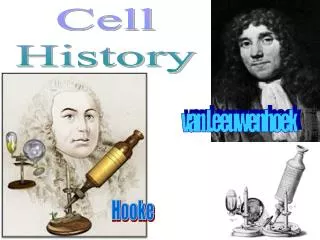
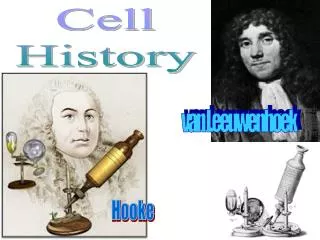
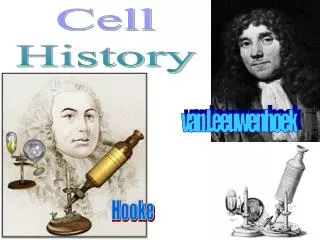
Cell History van Leeuwenhoek Hooke
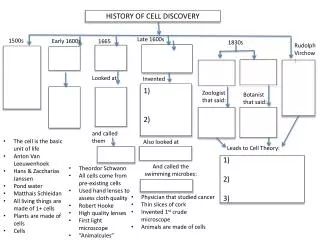
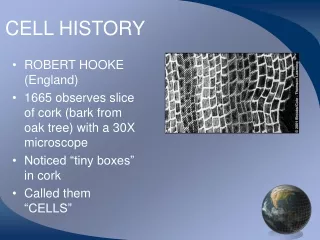
Cell History • All life is made of cells • Discovered after microscope invented • 1665: Robert Hooke first observed cork (dead plant bark) • Cork reminded him of tiny rooms • He named the empty boxes “cells”
Cell Theory Schleiden • Three Parts: • 1) All organisms are made of cells • 2) The cell is the most basic unit of life • 3) Cells come from other cells • What’s the big problem with this theory? Schwann Virchow
Cell Diversity • Shape depends upon function • Nerve Shape: Elongated branching • Function: Sends messages to and from brain • Red Blood Shape: Disc-like shape prevents clogging • Function: Carries O2 throughout blood • Skin Shape: Flat & broad; layers overlap • Function: Covers and protects the body
Cell Categories • 1) Prokaryote: Cells without a nucleus and other membrane-bound organelles • Oldest cells known (~4 billion years old) • Believed to have evolved first (oldest fossils) • AKA: Bacteria
2) Eukaryote: Cells with a nucleus & membrane bound organelles More complex cells Evolved from prokaryotes Ex: Protists, Fungi, Plants, Animals Cell Categories
Kobe Kuiz • Who first identified cells? • What was he/she examining? • Name the three parts to the cell theory. • Explain how the shape of a blood cell allows it to perform it’s job better. • Which category of cells contain nuclei? • Why are bacteria considered the oldest forms of life on Earth?