Download
1 / 61
670 likes | 818 Vues
The Baroque period, spanning from 1600 to 1750, is renowned for its elaborate ornamentation and grandeur in arts and music. Originating from the Portuguese term “barroco,” meaning “oddly shaped pearl,” this era saw the rise of absolute monarchies and the flourishing of orchestras and operas. Defining characteristics of Baroque music include unity of mood and continuity of rhythm, alongside innovations like the concerto grosso and various vocal forms such as opera and cantata. Key composers like Claudio Monteverdi and George Frideric Handel made significant contributions to this vibrant cultural movement.

E N D
BAROQUE PERIOD ORNAMENTATION AND ELABORATION OF ARTS & MUSIC
baroque • Period from 1600-1750 • From the Portuguese term “BAROCCO” which means “ODDLY SHAPED PEARL”
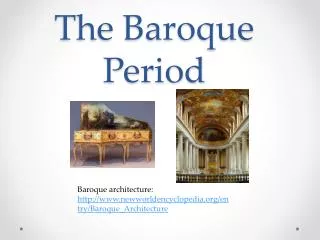
baroque • Recognized for ornateness, grandeur and flamboyance in architecture and painting. • A term initially used to imply strangeness and extravagance.
baroque • An era of absolute monarchy and aristocracy. • A period that begins the popularity of orchestra and opera.
Historical background • Puritans reached New England (1620) • Beheading of Charles 1 (1649) • Restoration of Charles II as King of England • Discovery of the Laws of Motion by Sir Isaac Newton
Baroque music CHARACTERISTICS: • Unity of mood • Continuity of rhythm • Continuous and repeated melody
Baroque MUSIC • Terraced dynamics • Shifting of the intensity of the volume from soft to loud and vice versa. • Birth of “NuovoMusiche” (New Music)
baroque • Italian words were used to tell how music is to be played. • Homophonic – MONODY (One/Solo Song)
ORGANS and HARPSICHORD are the main keyboard instruments, VIOLA DE GAMBA is for stringed instruments.
…BAROQUE MUSIC CAMERATA - Italian for “Salon” which refers to a group of Florentine writers, artists and musicians
CAmerata - They first cultivated the monodic style and realized that it could also be applied to an entire drama which later led to OPERA.
1. OPERA An art where musicians perform a dramatic composition putting the libretto (text) and musical score accompanied by orchestra or ensemble.
… OPERA • Themes are mostly based on history and mythology. • “L’Orfeo” is the first great opera by Claudio Monteverdi.
2. CANTATA • From the Italian word “cantare” which means “sung” • Is a vocal composition for a soloist or choir accompanied by instruments.
… CANTATA • Themes are based on a narrative poem of secular or religious, lyrical or dramatic in nature. • “Awake, A Voice is Calling Us” by J.S. Bach
3. ORATORIO • A dramatic but unstaged telling of a biblical or religious story • Uses no scenery or costumes and no dramatic actions
3. ORATORIO • Uses a narrator, soloists, chorus and an orchestra. • Usually performed in churches and concert halls.
… ORATORIO • It is meditative rather than dramatic in nature that deals with a New Testament subject but with no plot. • “Messiah” by G. F. Handel
1. Concerto grosso • Most important orchestral music in this period.
... Concerto grosso • Consists mainly of string instruments with few solo instrument (concertino) which plays in opposition to the whole orchestra called tutti.
TUTTI – composed of a hapsichord as part of the basso continuo, another stringed instrument.
... Concerto grosso • THREE MOVEMENTS: • FAST – vigorous and determined • SLOW – quieter; often lyrical and intimate • FAST – lively and carefree with a dance-like character
2. Baroque suite • It is developed by French which refers to a group of works held together by story, mood or idea.
. . . BAROQUE SUITE • Others terms are Partita (Germany), Overture and Sonata de Camara
. . . BAROQUE SUITE • “Water Music” by Handel • “Badinerie” from Suite No.2 in B Minor by Bach
1. Claudio giovanniantoniomonteverdi1567-1643 • An Italian composer and the most important figure in the transition from Renaissance to Baroque music.
1. Claudio giovanniantoniomonteverdi • One of the guest contributors to OPERA.
1. Claudio giovanniantoniomonteverdi • Musical Works: • L’ORFEO (1607) – first modern opera • ARIANNA (1608) – established his reputation as an opera composer
1. Claudio giovanniantoniomonteverdi • Only TWO of his opera has survived complete form: • The Return of Ulysses in His Homeland (II ritornod’Ulisse in patira 1641) • The Coronation of Poppea(L’incoronazione di Poppea 1642) – his masterpiece
2. GEORGE FRIDERIC HANDEL(1685-1759) • The Master of English Oratorio and Italian Opera
Musical Works: • ALMIRA (1704) – his first opera • AGGRIPINA (1709) • RINALDO (1711)
ATHALIA (1733) & SAUL (1939) – English Oratorios • WATERMUSIC and MUSIC FOR THE ROYAL FIREWORKS– orchestral music