

SlideServe
Menu
Préférences
© SlideServe · v2026

Pipelining in MIPS

vesta avatar
15 diapositives · 485 Views · Aug 14, 2014

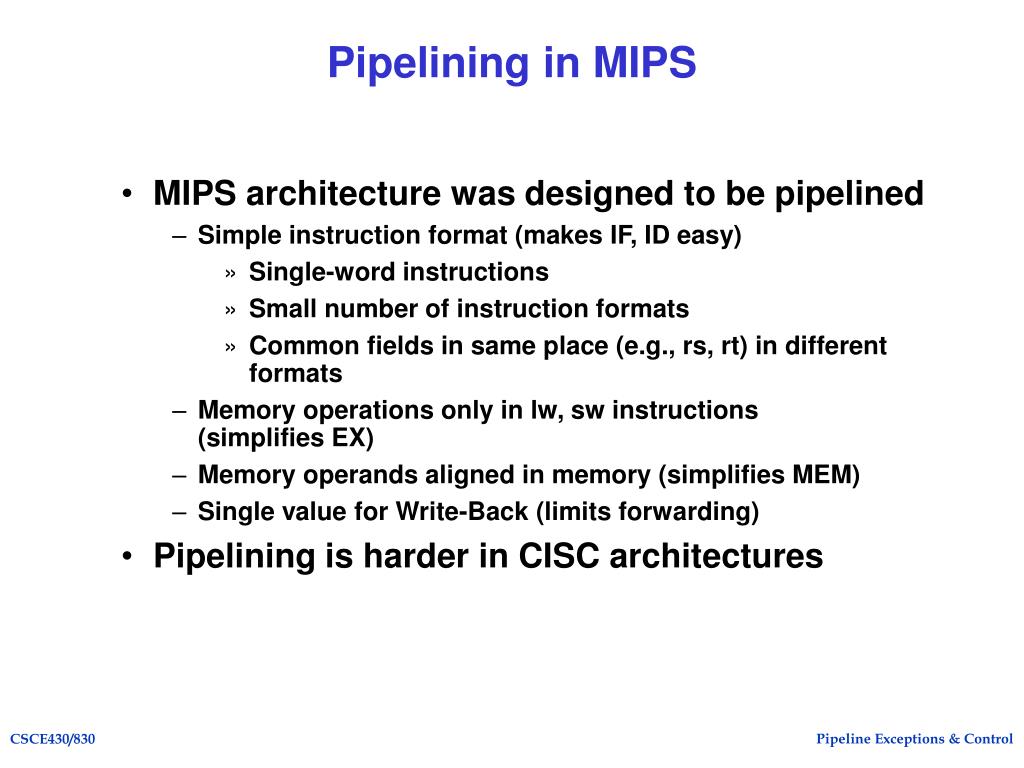
Pipelining in MIPS. MIPS architecture was designed to be pipelined Simple instruction format (makes IF, ID easy) Single-word instructions Small number of instruction formats Common fields in same place (e.g., rs, rt) in different formats
Pipelining in MIPS - slide 1
01 / 15Pipelining in MIPS
1 / 17

Télécharger la présentation

Pipelining in MIPS
Une image / un lien ci-dessous est fourni (tel quel) pour télécharger la présentation

Politique de téléchargement : le contenu du site vous est fourni TEL QUEL pour votre information et votre usage personnel ; il ne peut être vendu, concédé sous licence ni partagé sur d’autres sites sans l’accord de son auteur.Le contenu vous est fourni TEL QUEL, pour votre information et votre usage personnel uniquement. Téléchargez la présentation en cliquant sur ce lien. Lors du téléchargement, si vous ne parvenez pas à télécharger une présentation, l’éditeur a peut-être supprimé le fichier de son serveur.Pendant le téléchargement, si vous ne parvenez pas à obtenir une présentation, le fichier a peut-être été supprimé par l’éditeur.

F I N

Plus de contenu associé

Transcription de la présentation
  1. Pipelining in MIPS • MIPS architecture was designed to be pipelined • Simple instruction format (makes IF, ID easy) • Single-word instructions • Small number of instruction formats • Common fields in same place (e.g., rs, rt) in different formats • Memory operations only in lw, sw instructions (simplifies EX) • Memory operands aligned in memory (simplifies MEM) • Single value for Write-Back (limits forwarding) • Pipelining is harder in CISC architectures

  2. Pipelined Datapath with Control Signals

  3. Basic approach: build on single-cycle control Place control unit in ID stage Pass control signals to following stages Later: extra features to deal with: Data forwarding Stalls Exceptions Next Step: Adding Control

  4. Control for Pipelined Datapath RegDst ALUOp[1:0] ALUSrc MemRead MemWrite Branch RegWrite MemtoReg

  5. Control for Pipelined Datapath

  6. Datapath and Control Unit

  7. Tracking Control Signals - Cycle 1 LW

  8. Tracking Control Signals - Cycle 2 SW LW

  9. Tracking Control Signals - Cycle 3 1 0 01 ADD SW LW

  10. Tracking Control Signals - Cycle 4 0 0 1 SUB ADD SW LW

  11. Tracking Control Signals - Cycle 5 1 1 SUB ADD SW LW

  12. Class Exercise • Consider the following code segment • LW R1, 0(R4) • LW R2, 0(R5) • ADD R3, R1, R2 • BNZ R3, L • LW R4, 100(R1) • LW R5, 100(R2) • SUB R3, R4, R5 • L: SW R3, 50(R1) • Assuming that • there is no forwarding, • zero testing is being resolved during ID, and • registers can be written in the first half of the WB cycle and also be read in the send half of the same WB cycle, • Question: identify the resources of various hazards in the above code sequence.

  13. Class Exercise • Consider the following code segment • LW R1, 0(R4) • LW R2, 0(R5) • ADD R3, R1, R2 • BNZ R3, L • LW R4, 100(R1) • LW R5, 100(R2) • SUB R3, R4, R5 • L: SW R3, 50(R1) • Assuming that • there is no forwarding, • zero testing is being resolved during ID, and • registers can be written in the first of the WB cycle and also be read in the send half of the same WB cycle, • Question: identify the resources of various hazards in the above code sequence.

  14. Class Exercise • Consider the following code segment • LW R1, 0(R4) • LW R2, 0(R5) • ADD R3, R1, R2 • BNZ R3, L • LW R4, 100(R1) • LW R5, 100(R2) • SUB R3, R4, R5 • L: SW R3, 50(R1) Use compiler techniques to reshuffle/rewrite the code (without changing the meaning of the program) as to minimize data hazards as far as possible. Assume that no other general purpose registers other than those used in the code, are available.

  15. Class Exercise • Consider the following code segment • LW R1, 0(R4) • LW R2, 0(R5) • ADD R3, R1, R2 • BNZ R3, L • LW R4, 100(R1) • LW R5, 100(R2) • SUB R3, R4, R5 • L: SW R3, 50(R1) • LW R1, 0(R4) • LW R2, 0(R5) • LW R4, 100(R1) • LW R5, 100(R2) • ADD R3, R1, R2 • BNZ R3, L • SUB R3, R4, R5 • L: SW R3, 50(R1)