Periodic Table
Discover the fascinating history of the Periodic Table, tracing its roots from Antoine Lavoisier, the father of modern chemistry, to Dmitri Mendeleev, who revolutionized it in 1869 by arranging elements based on their properties. Learn about John Newlands' Law of Octaves, Julius Meyer’s contributions, and the impact of Henry Moseley’s reorganization by atomic number. The table has evolved with advancements like Glenn Seaborg’s identification of rare earth elements, shaping the way we understand chemical elements today.

Periodic Table
E N D
Presentation Transcript
History • Antoine Lavoisier – Father of Modern Chemistry • 1829 German J. W. Dobereiner Grouped elements into triads • Three elements with similar properties • Properties followed a pattern • The same element was in the middle of all trends • Not all elements had triads
Law of Octaves • 1862 John Newlands developed Law of Octaves • The elements showed a repetition in their chemical properties after 8 elements • Used Atomic Weights but not actual values • Important because showed the first pattern of repeating properties
Julius Lothar Meyer • Meyer first table published 1864 containing 28 elements • Arranged in order of Atomic Weight and made a clear horizontal relationship • Allowed properties (valency) to outweigh Atomic Weight • Anticipated Mendeleev by years
Meyer • Left gaps to denote unknown elements • Not willing to make predicitions • More focused on Physical properties not chemical properties • Bitter battle with Mendeleev • Lost to Mendeleev because of Mendeleev’s forceful ways
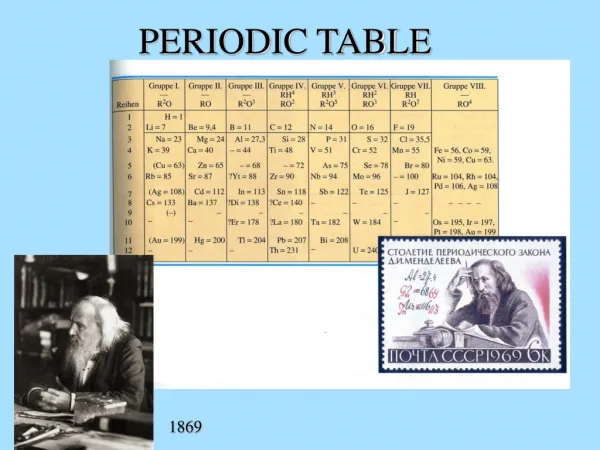
History • Russian scientist Dmitri Mendeleev taught chemistry in terms of properties • Mid 1800 – atomic masses of elements were known • Wrote down the elements in order of increasing mass • Found a pattern of repeating properties • Not first to develop system but his version had the strongest impact
Mendeleev’s Table • Grouped elements in columns by similar properties in order of increasing atomic mass • Found some inconsistencies - felt that the properties were more important than the mass, so switched order. • Found some gaps • Must be undiscovered elements • Predicted their properties before they were found
Dmitri Mendeleyev • Mendeleyev was known as the “Father of the Periodic Table” • DOB: 1834-1907 • Created the first table on 3-1-1869 • Table had 70 elements • Used properties to set up table
Mendeleev • Distinguished from competitors by a devotion to, and love for, the individuality of the elements that went hand in hand with an intimate knowledge of their chemical characteristics • Focused on both physical and chemical properties
Mendeleyev Cont. • Properties Used: • Atomic Weight • Melting Pts. • Densites • He could only predict these properties • His work preceded chemical advances by 30 years • Produced his table 27 years before the first subatomic particle, the electron was discovered • Did not predict Noble Gases
Acceptance • Mendeleev’s table received real acceptance in 1875 • Discovery of Scandium, Germanium and Gallium showed Mendeleev’s predictions were correct.
“The elements were not being arranged to make a periodic table, but to fit the periodic table”
Julius Meyer (1830-1895) Created a table that plotted: Atomic Volume vs. Atomic Weight Lost out to Mendeleyev Published before Meyer Final Table: Atomic Weight vs. Valency Table had 8 columns but was missing Noble Gases Discovered 30 years later Meyer vs. Mendeleyev
Changing of Table • Henry Moseley (1887-1915) – changed table in 1913 by increasing atomic number • Currently use this today • Glenn Seaborg – rare earth series from Actinium (89) up. • Minor Changes – inner transitional Lu & Lr replaced La & Ac • Bohr first linked Quantum Theory
First Elements Discovered: Carbon Sulfur Copper Gold & Silver Iron Tin Antimony Mercury Lead Oxygen (1772) First Classified Groups: Gases Non-Metals Metals Earths More History
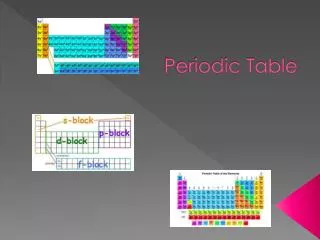
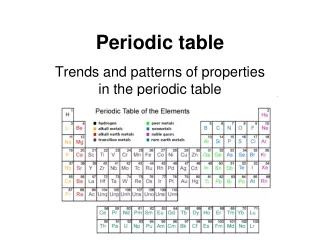
8A0 1A 2A 3A 4A 5A 6A 7A • The elements in the A groups are called the representative elements
Transition metals • The Group B elements
VIIIB IA IIA VIB VIIB IIIB IVB VB 1 1A 2 2A 8A 18 13 3A 14 4A 15 5A 16 6A 7A 17 VIIIA VIA VIIA IIIA IVA VA IB IIB 3 3B 4B 4 5 5B 6B 6 7 7B 8 8B 9 8B 10 8B 1B 11 2B 12 Other Systems
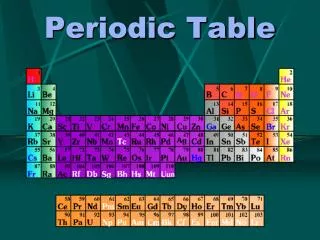
Vertical Columns • Known as Groups or a Family • Elements in same group have similar physical & chemical properties • Each group is identified by a group number and group letter
Horizontal rows are called periods • There are 7 periods
Group 1A are the alkali metals • Group 2A are the alkaline earth metals
Group 7A is called the Halogens • Group 8 are the noble gases
These are called the inner transition elements and they belong here The group B are called the transition elements
Metals & Their Properties • Metals are good conductors of heat and electricity • Metals are malleable • Metals have high luster
Example of Metals • Copper is a relatively soft metal and a very good electrical conductor • Mercury is the only metal that exists as a liquid at room temperature
Nonmetals & Their Properties • Carbon, the graphite in a pencil is an example of a nonmetallic elements • Nonmetals are poor conductors of electricity • Can be brittle • Non-lustrous • Many are gases at room temperature
Example of Nonmetals • Sulfur was once known as Brimstone • Microspheres of phosphorus, a reactive nonmetal
Metalloids or Semimetals • Properties of both • Semiconductors
Example of a Metalloid • Silicon is a metalloid • Silicon is brittle like a nonmetal • Silicon has metallic luster • Silicon is a semiconductor of electricity