SlideServe
Menu
Préférences
© SlideServe · v2026

Impact of IFH1 Mutations on Yeast Lifespan and GCN4 Expression

vianca avatar
1 diapositives · 148 Views · Jul 25, 2014

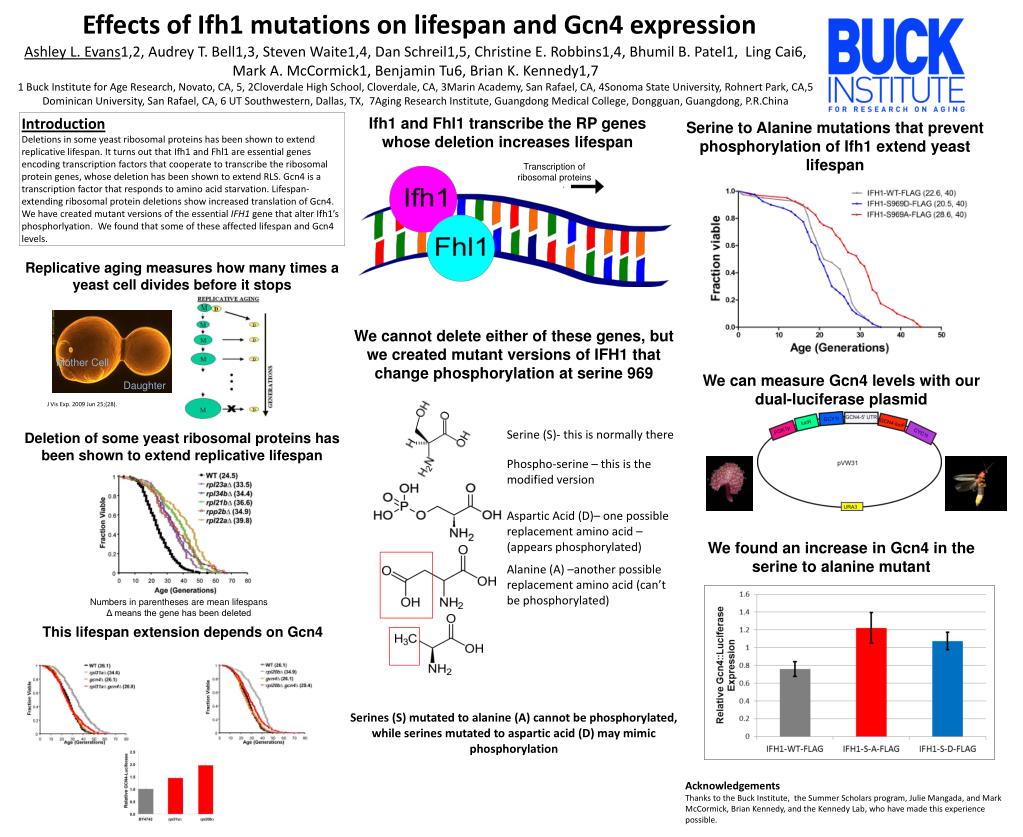
This study investigates the role of IFH1 mutations on the lifespan of yeast and the expression of GCN4, a crucial transcription factor. By creating mutant versions of the essential IFH1 gene that alter its phosphorylation, we analyze how these mutations affect yeast replicative lifespan (RLS) and GCN4 levels. Results indicate that serine to alanine mutations in IFH1 can extend lifespan by preventing phosphorylation and enhancing GCN4 translation. These findings highlight the intricate connection between ribosomal protein regulation and aging.
Impact of IFH1 Mutations on Yeast Lifespan and GCN4 Expression - slide 1
01 / 1Impact of IFH1 Mutations on Yeast Lifespan and GCN4 Expression
1 / 17

Télécharger la présentation

Impact of IFH1 Mutations on Yeast Lifespan and GCN4 Expression
Une image / un lien ci-dessous est fourni (tel quel) pour télécharger la présentation

Politique de téléchargement : le contenu du site vous est fourni TEL QUEL pour votre information et votre usage personnel ; il ne peut être vendu, concédé sous licence ni partagé sur d’autres sites sans l’accord de son auteur.Le contenu vous est fourni TEL QUEL, pour votre information et votre usage personnel uniquement. Téléchargez la présentation en cliquant sur ce lien. Lors du téléchargement, si vous ne parvenez pas à télécharger une présentation, l’éditeur a peut-être supprimé le fichier de son serveur.Pendant le téléchargement, si vous ne parvenez pas à obtenir une présentation, le fichier a peut-être été supprimé par l’éditeur.

F I N

Plus de contenu associé

Transcription de la présentation
  1. Effects of Ifh1 mutations on lifespan and Gcn4 expression Ashley L. Evans1,2, Audrey T. Bell1,3, Steven Waite1,4, Dan Schreil1,5, Christine E. Robbins1,4, Bhumil B. Patel1, Ling Cai6, Mark A. McCormick1, Benjamin Tu6, Brian K. Kennedy1,7 1 Buck Institute for Age Research, Novato, CA, 5, 2Cloverdale High School, Cloverdale, CA, 3Marin Academy, San Rafael, CA, 4Sonoma State University, Rohnert Park, CA,5 Dominican University, San Rafael, CA, 6 UT Southwestern, Dallas, TX, 7Aging Research Institute, Guangdong Medical College, Dongguan, Guangdong, P.R.China Ifh1 and Fhl1 transcribe the RP genes whose deletion increases lifespan Introduction Deletions in some yeast ribosomal proteins has been shown to extend replicative lifespan. It turns out that Ifh1 and Fhl1 are essential genes encoding transcription factors that cooperate to transcribe the ribosomal protein genes, whose deletion has been shown to extend RLS. Gcn4 is a transcription factor that responds to amino acid starvation. Lifespan-extending ribosomal protein deletions show increased translation of Gcn4. We have created mutant versions of the essential IFH1 gene that alter Ifh1’s phosphorlyation. We found that some of these affected lifespan and Gcn4 levels. Serine to Alanine mutations that prevent phosphorylation of Ifh1 extend yeast lifespan Transcription of ribosomal proteins Replicative aging measures how many times a yeast cell divides before it stops We cannot delete either of these genes, but we created mutant versions of IFH1 that change phosphorylation at serine 969 Mother Cell We can measure Gcn4 levels with our dual-luciferase plasmid Daughter J Vis Exp. 2009 Jun 25;(28). Serine (S)- this is normally there Phospho-serine – this is the modified version Aspartic Acid (D)– one possible replacement amino acid – (appears phosphorylated) Alanine (A) –another possible replacement amino acid (can’t be phosphorylated) Deletion of some yeast ribosomal proteins has been shown to extend replicative lifespan We found an increase in Gcn4 in the serine to alanine mutant Numbers in parentheses are mean lifespans Δ means the gene has been deleted This lifespan extension depends on Gcn4 Serines (S) mutated to alanine (A) cannot be phosphorylated, while serines mutated to aspartic acid (D) may mimic phosphorylation Acknowledgements Thanks to the Buck Institute, the Summer Scholars program, Julie Mangada, and Mark McCormick, Brian Kennedy, and the Kennedy Lab, who have made this experience possible.