Download
1 / 33
330 likes | 465 Vues
This guide provides a concise overview of various invertebrate phyla, including Porifera (sponges), Cnidaria (jellyfish, corals), Ctenophora (comb jellies), Platyhelminthes (flatworms), Rotifera, Lophophorata (bryozoans, phoronids, brachiopods), Nemertea (proboscis worms), Mollusca (snails, octopuses), Annelida (segmented worms), and Nematoda (roundworms). Key characteristics, such as body structures, symmetries, reproduction, and habitats are discussed, highlighting the diversity and biological significance of these essential organisms in aquatic and terrestrial ecosystems.

E N D
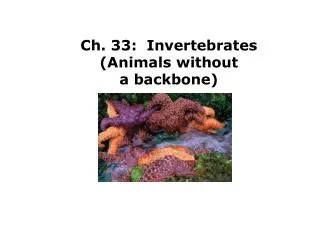
Ch. 33: Invertebrates (Animals without a backbone)
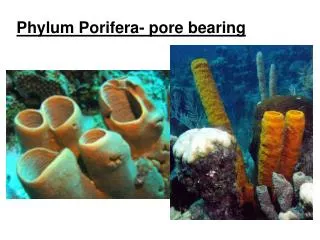
Phylum Porifera: • Sponges -Sessile (attached to bottom) -Spongocoel (central cavity) -Osculum (large opening) -Choanocytes (flagellated collar cells) -Hermaphroditic (produce both sperm and eggs)
Phylum Cnidaria: hydras, jellyfish, sea • anemones, and coral animals. -Diploblastic -Radial symmetry -Gastrovascular cavity (sac with a central digestive cavity) -Nerve net -Hydrostatic skeleton (fluid held under pressure) -Polyps and medusa -Cnidocytes (cells used for defense and prey capture) -Nematocysts (stinging capsule)
NOT the same as alternation of generations that occurs in plants as both polyp and medusa are diploid organisms.
Phylum Ctenophores: Comb jellies • -8 rows of • comblike plates • of fused cilia • (largest animals • that use cilia for • locomotion) • -Tentacles with • colloblasts • (adhesive structures that capture prey)
Phylum Platyhelminthes: Flatworms -Reproduce asexually via regeneration -Reproduce sexually; hermaphorditic cross-fertilization
-Bilateral; no body cavity -Predators, scavengers, parasites -Triplobastic; mesoderm but, GVC with only one opening – pharynx -Some cephalization – ganglia, eyespots -Many pathogens (Schistosoma, Cestodidias)
The blood flukeSchistosoma infects 200 million people,leading to body pains, anemia, and dysentery.
-Tapeworm (Cestodidias) absorb food particles from their host. -Tapeworm eggs are released in feces. -Contaminated food and water can infect host. -Tapeworm larvae encyst into muscles of host.
Phylum Rotifera: are pseudocoelomates • with jaws, crowns of cilia, and complete • digestive tracts. • 1,800 species, are tiny animals (0.05 to • 2 mm), most of which live in freshwater. -Internal organs in the pseudo- coelomates. -Pseudocoelomate acts as a hydro- static skeleton. -Pseudocoelomate also acts as a circulatory system.
-Some rotifers only exist as females, reproducing more females from unfertilized eggs (parthogenesis). -One type of rotifer produce 2 types of eggs: 1. Eggs that produce females 2. Eggs that produce degenerate males that live just long enough to fertilize eggs.
Phylum Lophophorate: Bryozoans, • Phoronids, and Brachipods. -Molecular data shows that lophophorates are protostomes. -Named Lophophores as they all have a common physical feature: the lophophore. • The lophophore is a horse-shoe-shaped or circular fold of the body wall bearing ciliated tentacles that surround the mouth.
-They also have a U-shaped digestive tract and the absence of a head. -True coeloms completely lined with mesoderm. -Bryozoans are colonial organisms: -Colony is usually encased in a hard exoskeleton. -Mostly marine -Sessile, coral reef builders
-Phoronids are tube-dwelling marine worms, 1mm to 50 cm long in length. -Some live buried in sand, within chitinous tubes. -The lophophore is extended with the phoronid is feeding. It is withdrawn when it feels threatened.
-Dorsal and ventral sides -Marine
Phylum Nemertea: Proboscis worms known • for the prey-capturing apparatus. -Resemble flatworms like tapeworms, but have fluid-filled sacs that resemble a true coelom. -Sometimes called “ribbon worms” -Have complete digestive and circulatory system. -Proboscis sticky, barbed, or poisonous
Phylum Mollusca have a muscular foot, a • mantle, and a visceral mass. -Slugs, snails, oysters, clams, octopus, and squids. -Marine and freshwater -Soft bodied with hard shell; slugs, octopus, and squids have lost or reduced during their evolution.
-Foot: used for locomotion -Visceral mass: contains the organs -Mantle: secretes the shell -Radula: used to scrape up food
-Most mollusks are separated sexes, but some snails are hermaphrodites. -The life cycle of many mollusks include a ciliated larva called a trophophore (also in Annelids). -8 classes: 1. Polyplacophora (chitons), 2. Gastropoda (snails and slugs), 3. Bivalvia (clams, oysters, and other bivalves), and 4. Cephalopoda (squids, octopuses, and nautiluses).
-Unique among the mollusks, the cephalopods have a well-developed brain and nervous system. -They also have a closed circulatory system.
Phylum Annelids: Segmented worms -Septa between the segments. -Digestive system -Closed circulatory system -Each segments contains a metanephridia, which excretes wastes Wastes excreted out through pores.
-Two brain-like ganglia in head -Hermaphrodites -Some can reproduce asexually by fragmentation and then regeneration
-3 Classes: 1. Oligochaeta (earthworms) 2. Polychaeta (marine segmented worms) 3. Hirudinea (leeches) Polychaeta Leech
-In annelids, the coelom plays a hydrostatic role. -Segmentation allows for specialization of body regions.
Phylum Nematodes: Roundworms are non- • segmented pseudocoelomates covered by a • tough cuticle. -90,000 species (with probably 10x more) -Size: 1mm to more than 1m -Lack a circulatory system -Complete digestive tract -Move by moving back and forth due to longitudinal muscles -Reproduce sexually with internal fertilization -Female can lay over 100,000 eggs
-Over 50 species of nematodes are parasitic to • humans. • Trichinella spiralis causes trichinosis when the nematode worms encyst in a variety of human organs, including skeletal muscle.
Phylum Arthropods: Segmented coelomates • with exoskeletons and jointed appendages. -Population: 1 billion billion (1018) -Nearly 1 million species (most successful animal phylum)
-Evolutionary success due to segmentation, exoskeleton, and jointed appendages. specialized body parts efficient labor