Understanding Thermochemistry: Energy Flow & Enthalpy in Chemical Reactions
170 likes | 276 Vues
Explore the fundamentals of energy flow and enthalpy in chemical reactions, including thermochemical equations and Hess' Law examples. Learn about the nature of energy, first law of thermodynamics, potential vs. kinetic energy, enthalpy, and more.


Understanding Thermochemistry: Energy Flow & Enthalpy in Chemical Reactions
E N D
Presentation Transcript
Thermochemistry Chapter 6! By James Lauer and David Miron
6.1 The Nature of Energy • Key Terms • First law of thermodynamics - The energy of the universe is constant • Energy - the capacity to do work or to produce heat • Law of Conservation of Energy - energy can be converted from one form to another but can be neither created nor destroyed • Potential vs Kinetic energy - energy due to position or composition and energy due to motion (KE=1/2mv2) • Heat - the transfer of energy between two objects due to temperature difference • Work - force acting over a distance • Pathway - can affect energy transfer but the total energy remains constant • State Function/Property - property dependent on present state of object • System - the part of the universe on which we wish to focus on • Surroundings - everything else in the universe • Exo- vs Endothermic - energy flows out of the system (combustion) and heat flows into the system • Thermodynamics - study of energy and its interconversions • Internal Energy (E) - the sum of kinetic and potential energy of all particle in the system (∆E = q + w)
6.1 Energy Flow In the final photo ball A’s potential energy has _______ and ball B’s potential energy has ______ Ball B is not as high (in the final photo) as Ball A was in the initial photo. Why? Where has some of the energy gone? What did it form?
6.1 Equations KE=1/2mv2 ∆E = q + w q=heat w=work ∆E=change in energy ∆E>0 endo/absorbed ∆E<0 exo, energy released +q=endo, flow in -q=exo, flow out +w=endo, work done on -w=exo, work done by Work = force X distance ---> w= -P∆V V=volume P=external pressure
6.1 Example Calculate ∆E for a system undergoing an endothermic process in which 15.6 kJ of heat flows and where 1.4 kJ of work is done on the system. (∆E = q + w) ∆E = 15.6 kJ + 1.4 kJ = 17.0 kJ Calculate the work associated with the expansion of a gas from 46 L to 64 L at a constant external pressure of 15 atm. (w = -P∆V) w = -15 atm X 18 L = -270 L x atm
6.2 Enthalpy and Calorimetry Key Terms Enthalpy(H) - H=E+PV state function Calorimeter - device used to determine heat associated with a chemical reaction Heat Capacity(C) - C=heat absorbed/increase in temperature Specific/molar heat capacity - heat capacity per gram(J/°C x g or J/K x g), heat capacity per mole(J/°C x mol or J/K x mol) Constant Pressure Calorimetry - basic calorimeter, to determine changes in enthalpy for reactions in solutions Constant Volume Calorimetry - rigid container (bomb) and reactants are ignited inside
6.2 Equations • H = E + PV H= enthalpy E= internal energy of system PV= pressure x volume • Chemical reaction ∆H = Hproducts - Hreactants • Constant pressure ∆H = qp qp= heat at constant pressure • Energy released by reaction = s x m x ∆T (specific heat capacity, mass of solution, increase in temperature) • Constant volume ∆E = q + w = qv • Energy released by reaction = temperature increase x heat capacity of calorimeter
6.2 Constant Pressure Constant Volume
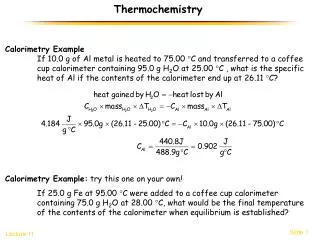
6.2 Example When 1.00 L of 1.00 M Ba(NO3)2 solution at 25.0°C is mixed with 1.00 L of 1.00 M Na2SO4 solution at 25.0°C in a calorimeter, the white solid BaSO4 forms, and the temperature of the mixture increases to 28.1°C. Assuming that the calorimeter absorbs only a negligible quantity of heat, that the specific heat capacity of the solution 4.18 J/°C x g, and that the density of the final solution is 1.0 g/mL, calculate the enthalpy change per mole of BaSO4. (∆H=specific heat x mass of solution x increase in temperature) Net ionic equation: Ba2+(aq) + SO42-(aq) ---> BaSO4(s) Mass of solution: 2L=2000ml=2000g Temperature increase: 28.1-25.0= 3.1°C 4.18 x 2000 x 3.1= 2.6 x 10⁴ J all units cancel except J 1000J = 1 kJ ∆H = -26 kJ/mol The reaction is exothermic.
6.3 Hess’ Law Key terms: Hess’ Law- states that in going from a particular set of reactants to a particular set of products, the change in enthalpy is the same whether the reaction takes place in one step or a series of steps. Hess’ Law allows scientists to determine the enthalpy of formation in a reaction they are unable to complete using a series of reactions containing the same reactants and products that are within the main reaction. Enthalpy of synthesis = - Enthalpy of Decomposition
6.3 Hess’ Law example What is the value for ΔH for the following reaction? CS2(l) + 2 O2(g) → CO2(g) + 2 SO2(g) Given: C(s) + O2(g) → CO2(g); ΔHf = -393.5 kJ/mol S(s) + O2(g) → SO2(g); ΔHf = -296.8 kJ/mol C(s) + 2 S(s) → CS2(l); ΔHf = 87.9 kJ/mol Using this info we can infer from hess’ law CO2(g)--> C(s) + O2(g)→→→; ΔHf = 393.5 kJ/mol SO2(g)--> S(s) + O2(g)→; ΔHf = 296.8 kJ/mol CS2(l)--> C(s) + 2 S(s); ΔHf = -87.9 kJ/mol
6.3 Hess’ Law example Focus on compounds What is the value for ΔH for the following reaction? CS2(l) + 2 O2(g) → CO2(g) + 2 SO2(g) Given: C(s) + O2(g) → CO2(g); ΔHf = -393.5 kJ/mol S(s) + O2(g) → SO2(g); ΔHf = -296.8 kJ/mol C(s) + 2 S(s) → CS2(l); ΔHf = 87.9 kJ/mol Using this info we can infer from hess’ law CO2(g)--> C(s) + O2(g)→→→; ΔHf = 393.5 kJ/mol SO2(g)--> S(s) + O2(g)→; ΔHf = 296.8 kJ/mol CS2(l)--> C(s) + 2 S(s); ΔHf = -87.9 kJ/mol CS2(l)--> C(s) + 2 S(s); ΔHf = -87.9 kJ/mol S(s) + O2(g) → SO2(g); ΔHf = -296.8 kJ/mol S(s) + O2(g) → SO2(g); ΔHf = -296.8 kJ/mol C(s) + O2(g) → CO2(g); ΔHf = -393.5 kJ/mol CS2(l) + 2 O2(g) → CO2(g) + 2 SO2(g); ΔHf = -1075.0 kJ/mol
6.4 Standard Enthalpies of Formation Key Terms Standard enthalpy of formation (Δ Hfo ) - the change in enthalpy that accompanies the formation of one mole of a compound from its elements with all substances in their standard states. Degree symbol (o) - indicates that the process is carried out under standard conditions Standard State - a precisely defined reference state. Compound: Gas: 1 atm Liquid or solid: Pure liquid or solid Solution: 1 M Element: 1 atm and 25oC
6.4 Things to wrap your head around: You cannot measure absolute absolute values for enthalpy...you can only determine changes in enthalpy (hence Δ ) Because Enthalpy is a state function, you can use Hess’ Law and manipulate it so you can use it. soSynthesis = -Decomposition etc.
6.4 Equations Δ Horeaction = ΣnpΔHof(products) - ΣnpΔHof(reactants) Public Relations P-R
6.4 examples Calculate ΔH for the following reaction: 8 Al(s) + 3 Fe3O4(s) --> 4 Al2O3(s) + 9 Fe(s) Given ΔHf Al2O3(s) = -1669.8 kJ/mol ΔHf Fe3O4(s) = -1120.9 kJ/mol First ignore the elements, because they are formed, and you don’t need them to find the change in enthalpy 3 Fe3O4(s) --> 4 Al2O3(s) Public Relations… P-R so ΔH = 4 ΔHf Al2O3(s) - 3 ΔHf Fe3O4(s) ΔH = 4 (-1669.8) - 3(-1120.9) = -3316.5 kJ/mol