New Development Partnership for Financing Sustainable Growth
200 likes | 280 Vues
Explore the Monterrey Consensus and private sector involvement to attract capital, mobilize resources, and enhance market access for sustainable development. Learn about FDI, PPP, and global financing mechanisms.


New Development Partnership for Financing Sustainable Growth
E N D
Presentation Transcript
Financing for Development(FfD) Monterrey-Consensus New development partnership based on a framework of mutual accountability between: Developed and developing countries Public, private and civil sector
Instruments (among others): • Establishing an investment climate to attract private capital • Mobilize domestic financial resources • Promote improved market access
Private Sector(Definition) • Privatisation • Private-Public-Partnership (PPP) • TNE • Private capital flows • Business – Civil society engagement • Domestic private sector (SME)
Business – Civil society engagement • EDF – McDonald‘s on solid Waste Management • Clean Clothes Campaign • WWF • Max Havelaar /Fair Trade etc. See IDR Reports Vol 17, No 1, 2001 (www.jsi.com/idr)
Domestic private sector Small and medium enterprises (SME): • 80 % of all jobs. • Poor policies, institutions, lack of finance, many barriers (Hernan de Soto).
Effective support of small scale enterprises • Reform and restructuring of the domestic banking system (micro-finance schemes) • Improvement in property rights • Effective public services (rural roads, electricity, water) • Targeted subsidy systems • Technical assistance
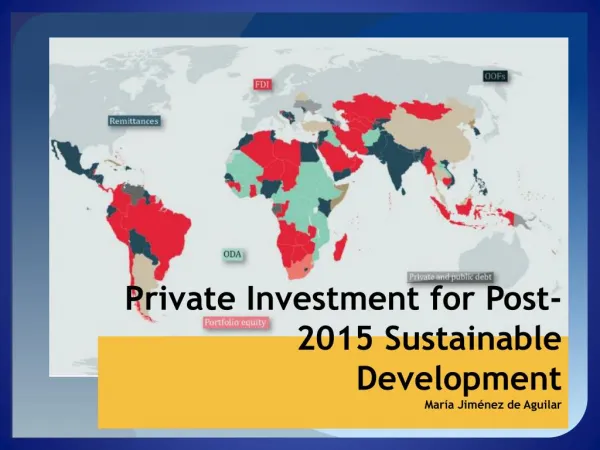
Private Capital Flows Different forms of private flows: Bank Lending, Bond Financing, Equity flows (PFI), Foreign DirectInvestment (FDI)
Foreign Direct Investment (FDI) • Resistance to crisis • Concentration:Top 10 countries: 73 %Top 30 countries: 93 %(Market size/Investment climate) • Regional concentrationChina: 90% of FDI in coastal regionsMexico: central states/bordering states to the USAIndia: 75% for the top 5 states (Maharashtra, Tamil Nadu, Karnataka, Andhra Pradesh, Delhi) • Free production zones • Reflows, Outflows
FDI:Requests • Broader repartition • Backward and forward linkages • Greenfield Investments • Reinvesting earnings • Social and environmental standards • Transfer of technologies, Know-how • Training
Privatisation • A cure for economic‘s ill? • Unproductive state enterprises with huge losses • Poor control mechanism: corruption • Poor competition level: new monopolies • Red carpet policies • Goal: raising large sums for
Public-Private-Partnership (PPP) • Central Issue • Actors: UN, WB, REB, Bilateral donors, DC, etc. • Forms: - Commercial relations- Institutional cooperation- Normative-regulating cooperation- Strategic cooperation- Infrastructure
PPP in infrastructure • Water, sanitation, environment, health, education, transportation, Telecoms etc. • Attracting private capital • New role for governments: retreat from former role as owners, new focus on regulator • Goals: improved efficiency, fiscal benefits, improved access, risk sharing
PPP in infrastructure (2) • Forms: Management contract, Leases, Concession, Divestiture • Risks:- Complicated procedures- Corruption- Red carpet (subsidies)- Participation- No „free lunch“, costs must be paid by users or by taxpayers- Credibility of private partners- Rules of the game, regulation capacity
PPP: requests • Civil society participation • Transparency • No conflicts, no opposition • No bad repudiated companies, corporate responsibility • Standards and codes • Technical assistance and capacity building • No high risks
Global Compact • 9 principles agreed between UNO and the business community • Different interest: Undermining values and mission of the UN, creeping privatisation of the UN?) • Volunteer, no binding rules • PR/blue washing of TNE?
OECD Guidelines for TNE • Guidelines for TNE, recommended by OECD countries to the TNE • Binding for OECD countries • Volunteer,not binding for TNE • Set by Northern countries • Lack of transparency