Understanding DNA Replication, Transcription, and Translation in Molecular Biology
This comprehensive overview covers the essential processes of DNA replication, transcription, and translation. It highlights the roles of key components such as the replisome, RNA polymerase, and ribosomes, and explains the significance of various mutations, including point mutations and larger genomic changes. The text delves into the mechanics of gene expression, emphasizing how these processes contribute to laboratory techniques and diagnostic applications, including the clinical implications of hereditary diseases such as sickle-cell and cystic fibrosis.

Understanding DNA Replication, Transcription, and Translation in Molecular Biology
E N D
Presentation Transcript
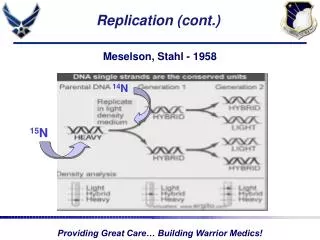
Replication (cont.) 14N 15N Meselson, Stahl - 1958
Replication (cont.) • Replication Fork • Prokaryotes • Eukaryotes • Ingredients • Replisome • dNTPs • Template ssDNA • Energy to form bond • Hydrolysis of extra phosphates • Add 5’ to 3’-end of hanging hydroxyl
Replication (cont.) • Replicons • Prokaryotes • Eukaryotes • Replisome components • DnaB, DnaG, Pol III, SSBs • Semi-discontinuous Synthesis • Leading and lagging • Okazaki fragments • Ligase
Replication (cont.) • Why is replication important to a lab tech? • Mutations • Point mutations - nonsense, missense, silent • Transitions (G:C to A:T) • Transversions (A:T to T:A) • Sickle-cell disease - due to missense point mutation in beta Hgb gene (valine inserted over glutamic acid) • Base mispairing (e.g., A:C?) • Deletions/Insertions (e.g., transposons)
Transcription • Proteins aren’t made in nucleus • Need transition medium for passing information • Messenger RNA (mRNA) to rescue! • Differences in DNA and RNA • Pentose used Ribose (2’ carbon) • Pyrimidine used Uracil vs. Thymine • Single-stranded; can bond with itself • Classes: mRNA, rRNA, tRNA, RNAi
Transcription (cont.) • 4 phases • Initiation • Elongation • Termination • Post-transcriptional mods
Transcription (cont.) • Transcription Bubble • Melt • Dock/Initiate • Extend • Close • Transcript unstable • 5’-methylated guanosine cap • Poly-A tail • Protects against exonucleases • Transcript transported outside nucleus
Transcription (cont.) • Post-transcriptional modifications • Keeping “tasty bits” • Exons - Conserved • Selective pressure • Introns - Not conserved • Lack of selective pressure • Remove these!
Transcription (cont.) Polymerase mRNA
Transcription (cont.) • Why is transcription important to lab techs? • Pathology can erupt all along Central Dogma • Mutations! • Natural background mutation rate • Repair mechanisms • Molecular basis of evolution • Mutations can be advantageous or problematic • Sickle-cell disease • Cystic fibrosis • Mutations that cause HIV resistance?
Translation Polymerase Ribosome mRNA
Translation Codons Ribosome
Translation • How is protein made from mRNA? • Protein synthesis ribosome • mRNA transcript contains codons • 3-base triplet synonymous for certain amino acid • ORF (open reading frame) • Each amino acid may have >1 corresponding codon • Other way around? NO!
Translation (cont.) • Each codon has matched tRNA • Amino acid attaches to tRNA
Translation (cont.) Tertiary Secondary Primary?
Translation (cont.) • 4 phases • Initiation • Elongation • Termination • Post-translational mod? • Amino acid structure • +NH3-CH[R]-COO-
Translation (cont.) A A E E P P
Translation (cont.) • Structural levels • Primary • Secondary • Tertiary • Quaternary
Translation (cont.) • Why is translation important to lab techs? • Protein basis for many traditional lab assays • Protein electrophoresis • Hemoglobinopathies • Sickle (quality) • Thalassemias (quantity) • Enzyme kinetics assays • CK, LDH, lipase, amylase, etc. • Colorimetric assays • Total protein, albumin • Lipoproteins • All proteins have genetic origin • Errors in translation/post-translation mods