Drawing Organic Structures
This overview discusses the representation of organic compounds through molecular and structural formulas. It emphasizes the importance of covalent bonds in holding organic structures together. Using examples like methane (CH4), cholesterol (C27H46O), cyclohexane (C6H12), and benzoic acid (C7H6O2), we explore how molecular formulas represent relative atom counts but lack information about bonding and structure. The piece highlights techniques for simplifying structural formulas while retaining key structural and functional features, differentiating solubility in solvents, and offering insights into properties of specific organic compounds.

Drawing Organic Structures
E N D
Presentation Transcript
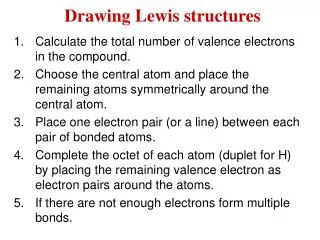
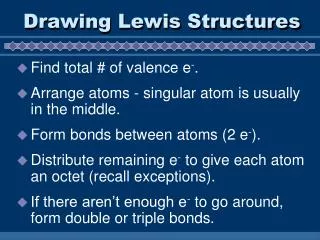
Drawing Organic Structures • Organic compounds are held together by covalent bonds • a covalent bond may be represented by a pair of dots, or by a single line
Molecular formula • Use methane as an example • CH4 • molecular formula • shows relative numbers of atoms • conveys no sense of structure or bonding • conveys no sense of chemistry
Writing Molecular Formulas • The number of carbon atoms is specified first • The number of hydrogen atoms is specified next • The remaining atoms are then specified in (usually alphabetical) order • cyclohexane: C6H12 • benzoic acid: C7H6O2 • ethyl para-aminobenzoate: C9H11NO2 • picryl chloride: C6H2ClN3O6
Full structural formula • every atom specified • every bond explicitly shown • methane is simple • two structures convey the same information about as efficiently
Now lets try it with cholesterol as the example… • Molecular formula • C27H46O
How do we simplify this? • recognize that every organic compound contains carbon • delete the symbol for carbon atoms except for those explicitly involved in a functional group (CHO, COOH, CN)
Can we make it simpler…? • We have removed all the carbon symbols (every organic compound contains carbon) • Practically every carbon compound contains hydrogen • delete symbol for hydrogen except where it is part of a functional group (e.g. CHO, OH)
Lets try that… • Dramatic simplification • structural features are visible • three rings • length and shape of side chains
Lets try that… • Dramatic simplification • structural features are visible • functional groups are visible • OH group of alcohol • C=C double bond
Lets try that… • Dramatic simplification • structural features are visible • functional groups are visible • information is more available • how long does it take to find the important features?
The molecules of this experiment • cyclohexane • C6H12 • toluene • C7H8 • benzoic acid • C7H6O2 • ethyl para-aminobenzoate • C9H11NO2
Properties • all electrically neutral • all soluble in non-polar solvents (e.g. ether) • none soluble in water to an appreciable degree • cyclohexane & toluene are liquids • benzoic acid and ethyl para-aminobenzoate are solids
Benzoic acid • a carboxylic acid • has one acidic hydrogen • weak acid • only slightly ionized • pKa ≈ 4 • reacts with base to give benzoate anion and water
benzoic acid molecules are converted by strong base into benzoate anions • benzoate anions are converted by strong acids into benzoic acid molecules
benzoic acid neutral, covalent molecules soluble in non-polar solvents (e.g. ether) almost insoluble in water sodium benzoate sodium cations and benzoate anions almost insoluble in non-polar organic solvents (e.g. ether) soluble in water A comparison
Ethyl para-aminobenzoate • has both ester (neutral) and amine (base) functional groups • has one basic nitrogen • weak base: gives practically no OH— in water • reacts with acid to give alkylammonium cation
ethyl p-aminobenzoate molecules are converted by strong acid into alkylammonium cations • the alkylammonium cations are converted by strong bases into ethyl p-aminobenzoate molecules
ethyl p-aminobenzoate neutral, covalent molecules soluble in non-polar solvents (e.g. ether) almost insoluble in water the alkylammonium salt alkylammonium cations and sulfate or chloride anions almost insoluble in non-polar organic solvents (e.g. ether) soluble in water A comparison