Key Aspects of the Italian Renaissance (1300-1600)
100 likes | 204 Vues
Explore the vibrant Northern Italian economy, politics of city-states like Florence and Milan, influence of notable figures such as the Medici family and Niccolo Machiavelli, and the rise of Humanism emphasizing education and individualism.


Key Aspects of the Italian Renaissance (1300-1600)
E N D
Presentation Transcript
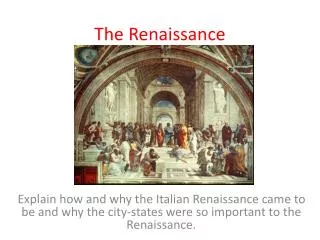
THE RENAISSANCE Italy (1300-1600)
Northern Italian Economy • Cities developed international trade: Genoa, Venice, Milan. • popolo(middle class) took power in 13th century; republican gov’t short-lived • signori (despots) or oligarchies (rule of merchant aristocracies) by 1300 • commenda: Contract between merchant and “merchant-adventurer” who agreed to take goods to distant locations and return with the proceeds (for 1/3 of profits)
Politics of Italian City-States • Republic of Florence (Included Republic of Genoa) – Medici family • Cosimo De’Medici (1389-1464): allied with other powerful families of Florence and became unofficial ruler of the republic • Lorenzo the Magnificent (1449-1492): lavish patron of the arts
Politics of Italian City-States • Girolamo Savonarola (1452-1498) – theocracy in Florence 1494-98; (predicted French invasion due to paganism and moral decay of Italian city-states); burned at the stake Charles VIII (1483-1498), French invasions of Italy; Italy became battleground for international ambitions
Politics of Italian City-States • Duchy of Milan -- Sforza family (Caterina Sforza (1463-1509), great art patron) • Rome, the Papal States – papacy (“Renaissance popes”) • Naples, Kingdom of the Two Sicilies Venice, Venetian Republic • Isabella d’Este (1474-1539): most famous Renaissance female ruler (ruled Mantua) • condottieri: leaders of private armies hired by cities for military purposes
Humanism • Humanism -- Revival of antiquity (Greece and Rome) in literature • Individualism/ secularism: “man is the measure of all things” • virtú: the quality of being a great man in whatever noble pursuit • Education: (emphasis on Latin and Greek)
Humanism • Petrarch—(1304-1374) “Dark Ages” metaphor; “father of humanism” and 1st modern writer, literature no longer subordinate to religion • Dante – Divine Comedy • Boccacio – Decameron: aimed to impart wisdom of human character and behavior. • Pico della Mirandola (1463-1494) Oration on the Dignity of Man; Platonic academy • Baldassare Castiglione(1478-1529) – The Book of the Courtier
Humanism • Leonardo Bruni (1370-1444) – wrote history of Florence; division of historical periods; narrative form; civic humanist; first to use term “humanism” • Lorenzo Valla (1407-1457)—On the False Donation of Constantine (1444); study of Latin • Niccolo Machiavelli (1469-1527) -- The Prince (1513) – Cesare Borgia