Download
1 / 12
120 likes | 233 Vues
Dive into the fundamental aspects of design with an exploration of lines, colors, textures, values, shapes, forms, and spaces. Learn how each element influences visual compositions and impacts overall aesthetics.

E N D
Elements of Design Written by Pat Thrash
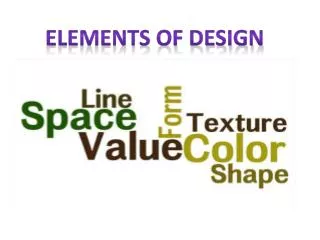
Line • A mark drawn with a pointed, moving tool. • Lines have different lengths, widths, textures, directions, and degrees of curve.
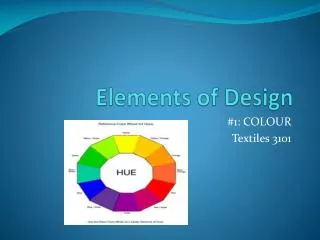
Color • Color is an element of design that is derived from reflected light. • Color has three properties: hue, value, and intensity.
Properties of Color: • Hue-the name of a color. The primary hues are red, yellow, and blue. • Value-refers to the lightness or darkness of an object. • Intensity-refers to the brightness and dullness of a color.
Texture • Texture is the element of design that refers to how things feel, or look as if they might feel if touched. • Texture can be: hard, soft, rough, smooth, slippery, sticky, scratchy.
Value • Value is the element of design that refers to lightness or darkness.
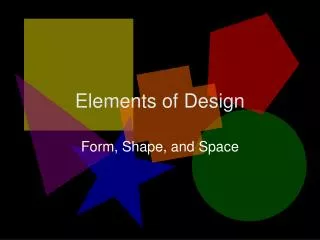
Shape • Shape is a two dimensional area that is defined in some way. It can be defined through line, color, or value. Shape has only height and width.
Form • Form is the element of design that includes objects that have three dimensions. • Form has height, width, and depth.
Space • Shapes are defined by space around and within them. • Space, or negative space, is the element of design that refers to the emptiness or area between, around, below, or within objects.