Night Essay
>>> How to write an essay? Order on the website: HelpWriting.Net

Night Essay
E N D
Presentation Transcript
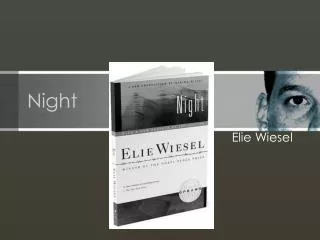
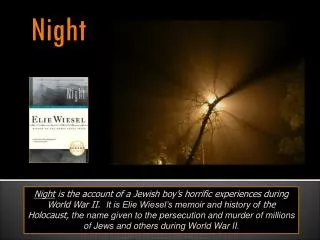
Night, By Elie Wiesel In this lesson, we will explore three of the major themes of 'Night ' and the imagery that the author, Elie Wiesel, uses to create them. The themes we will discuss are identity, silence, and night. !!!About the Book If you were an observant Jew who believed in a loving God, then you and your family were captured by a group of ill–intentioned people, causing the death of your family, what would you think about whether God and humans are good or not? That is the main concern of Eliezer, the main character in ' 'Night. ' ' ' 'Night ' ' was written by Romanian Jew, Elie Wiesel, and is a __semi– autobiographical__ work, meaning the author intertwines his/her life and experiences with a fictional story. ' 'Night ' ' tells the story about a Jewish boy, Eliezer, and his father 's experience in the Birkenau/Auschwitz and Buchenwald concentration camps during World War II. Wiesel experienced the same things as Eliezer, but includes additional fictional stories and details about the characters to create more of a novel than a memoir. The main focus of the book is to reflect on Eliezer 's questioning of God 's nature, and even his existence, as well as the nature of humanity during his experience in the Holocaust. Wiesel uses the following themes to create this engaging story: *identity *silence *night !!!Loss of Identity At the beginning of the book, we meet Eliezer who is an observant Jewish boy. This involves not only having faith in God (whom Eliezer believes is ...Get more content on HelpWriting.Net...
Night Descriptive Writing I walked down the snowy pavement pasting by the lamppost and groups of teenager smoking on cigarettes, I flicked on his hoodie feeling irritated by the sight and smell. I continued to walk on the pavement still hear cars bustling down the road with headlights illuminating the night, my breath formed swirls of mist. I started to walk into the darkness of the streets, I trudged through the slushy snow that was pure white. The rain started to rain harder and the sky grew darker, I felt of unease I have a feeling that something was following me, but I shrugged it off the thought maybe I was just overthinking things I continued to stroll through then making a sharp turn. I notice a white van that came thundering down the street. I continued...show more content... The ropes binding me to the chair were cutting into my wrists, burned from the tugging for freedom. Every breath I took was shallow became into desperate gasps for air as my lungs were breaking down, my throat suffocating me. The door creaked open "hello sir" the voice said, it was a mans and it sounded awfully familiar. "We're going to have lots of fun today..okay?" He said, there was a loud sound of the clinking of hard metal was being sharpened, my heart froze and muscle tensed I gave the rope jerk but only to be greeted piercing pain. I felt his eyes on me and panic rose, I desperately tried to ...Get more content on HelpWriting.Net...
A Cold And Windy Night Essay On a cold and windy night, some seventeen years earlier, a knock came upon the front door of Claymore Academy. Headmaster Quin, who had fallen asleep in his chair by the fireplace, awoke, uncertain of what had disturbed his slumber. He sat upright, now completely alert, and listened intently to the sounds within, but the occasional snores from the sleeping quarters or the chimes of the clock in the hall were nothing out of the ordinary and could not have been the reason for his abrupt awakening. He sat calmly and quietly, until he heard the sound again. Someone was at the front door. He got up and swiftly walked down the hallway, glancing at the clock as he went by, 2:00 A.M. Opening the door, he saw a soldier disappearing down the road. He could not make out his affiliation in the darkness and stepped outside to call out to him, but his foot bumped into something on the stoop, some kind of parcel, wrapped in a silk blanket. Bending over, he picked it up and took it inside to his study. A bloodied note was pinned to the outside, and he reached to turn up the lamp's flame next to his chair. Written on the note in bold but definitely feminine handwriting was only the word, Mangus. He carefully unwrapped the silken blanket to find a sleeping child, perhaps only a few weeks old, and a pouch heavily weighed with coins. His unusual arrival was most likely a result of the Great War and the dangerous times that men now lived in. He walked down the hall and gently rapped ...Get more content on HelpWriting.Net...
Night, Hope, By Elie Wiesel Forty–two years after entering the concentration camp for the first time, Elie Wiesel remarked, "Just as man cannot live without dreams, he cannot live without hope" (Nobel Lecture 1). This means a lot from someone who endured almost two years of the terror in the WWII concentration camps. During these two years, Elie endured the sadness of leaving his former life and faith behind, the pain of living off of scraps of bread, and the trepidation of the "selections", where he almost lost his father. He watched the hanging of innocent people, was beat by Kapos and guards time after time, and marched in a death march right after having a foot surgery. Through all of this, he survived because he remained hopeful. Hope was all the Jewish people...show more content... Even as the war got closer, the Jewish people remained hopeful and they tried to see the good in things, as absurd as it sounds. For example, when they were forced into the ghettos, people looked on the bright side, and found good things about them. Elie, looking back on the ghettos experience stated, "People thought this was a good thing. We would no longer have to look at all those hostile faces, endure those hate–filled stares" (Wiesel 12). So, even after the hate of the Germans had reached Sighet, the people were still thinking positive. They never even ventured to think about how situations could turn negative. When things did get negative, and they learned that they would have to be transported, they started having more pessimistic thinking, but they still were counting on a miracle to pull through for them. When Elie asked his father when they were expected to depart, he replied, "'The day after tomorrow. Unless...things work out. A miracle, perhaps...'" (Wiesel 18). This shows that Elie's family still had hope as they were going to be transported. They were more worried than they had been before, but they still had hope for a miracle. Overall, at the beginning of the book the characters were very hopeful and optimistic, even though scary events were happening around them. Next, as the book progressed, ...Get more content on HelpWriting.Net...
Night Essay In reading, Night by Elie Wiesel and A Man's Search For Meaning by , many stories of the torturous life in the concentration camps during the second world war. In each book, the reader gets a different point of view from each book because in Night, you get to read about a teenager's view and in the book, A Man's Search For Meaning, you get to read about a middle aged man's view. In the book, Night, Elie, his family and his community go through a system of indoctrination which in each step it makes you seem less and less of a human. The first step is that the Hungarian police made all the Jewish people wear yellow stars, so they could be picked out easily. The next step is that all the Jewish people had to get rid of all their valuable...show more content... The next step is that all the people had to get tattooed and the tattoo was that of a number and that number now replaced your name. Then after that the sent you into room and they gave you the same clothes. After that moment you definitely lost your individuality because you looked like everyone else and everything about you has been taken away so you start to think that you a just one of a million. These ideas are taken from pages 8 to 39 in the book, Night. The concentration camps seemed to bring out the worst in people because what happen was that all the people there reverted to animals and they only thought on their minds was me. Most of them wanted to survive as an individual rather than helping out and surviving as a group. One example of this is when the relationship the young and old is not that good. The young felt like the old was hindrance to there survival because they had to worry about themselves and it was more work and stress if they had to worry about someone else. One example of this is when Idek, the little Jewish boy, began to beat Elie's father because Idek felt that Elie's father was not working to his potential and that could get Idek in trouble. If Idek let Elie's father slack off, then he would get in trouble because all the work has not been done and when you get in trouble it usually means a beating and or death. This can be seen on page 52 of Night.The issue of primary ...Get more content on HelpWriting.Net...
Night Creative Writing When I was younger, I wanted nothing more than to dance under the moonlight and follow the fireflies out into some incredibly unexplored land. The night was for sleepovers and camping, secret bike riding and exploring– the moon was my mother and the stars my siblings. I used to lay in the grass and stare up, up, up into that endless sky intrigued by its mystery, longing to know the depths from which it spurred. The dark would tuck me in at night like the blanket it was, and I lived happily in the fact that I was a child and knew very little of it's secrets. Now older and less naive, the dark is a catacomb of panic. The night is now where men become monsters, and darkened streets are their nests. Where I used to dance under starlight, I now shy away from shadows and instead cling to lampposts. Hands clutched to my side ready for a defensive strike, I ask myself if I'll become another statistic, or if the man on the other side of the street will become another name forgotten. I wonder how it is that something that started off so utterly whimsical twisted it's shape into an unrecognizable cruelty. In day we laugh at fantastical oddities, and at night they suddenly become real. There's no need for imaginary horrors, they take the shape of man and women and go by the names of Adam and Eve. The point is we're the monsters, we're the scary things that lurk in the dark. We are...show more content... I take comfort in dusk, and bathe in dark. I like the feeling of one in the morning, and inexplicable silence, but it is no longer an option to have childish whims. I think more than anything I think I miss the simplicity of childhood nights, it lacks the laws of our current adult evenings: never leave a party without a friend, always have a backup number, stay in the light, don't wander far from home, kindly say goodnight to strangers and pray to God they don't follow you home. I don't fear the night, but I am one of many who understands it's ...Get more content on HelpWriting.Net...
Night Essay: Examples of Night "I became A–7713. From then on, I had no other name." (42) Elie Wiesel's Night is about a young Jewish boy and his experiences through the Holocaust in the 1940's. Any human being should never experience the hell–like terror that Elie had to go through. He is separated from his mother and his sister and is deported to Auschwitz, one of Hitler's most depressing concentration camps. Wiesel uses night not only as the title but also as a symbol of time, a world without God, and man's inhumanity to man. Night is defined as a time of day when the sun is dormant, but for Elie Wiesel, night is eternal. While stuck inside the camp, hope is quickly diminished in Elie's mind, overtaken by the deep darkness that night brings. This can be clearly...show more content... If God could be seen as light, then the loss of faith is his darkness. On page 60, Elie experiences a young boy being hanged as a punishment inside the camp. From witnessing the awful sight it reminds Elie of the harsh reality of the Nazi's and how they have deteriorated his faith, a vital component for staying alive in the camp. Elie then hears a question come from behind him. "Where is god now? And I heard a voice within me answer him: Where is he? Here he is– He is hanging here on his gallows . . ." (62) Elie felt as though God no longer had his support and that he had lost faith within him. He explains the young, innocent boy dying in front of him as his faith slowly slipping away. Elie began to doubt the support from God. "I did not deny God's existence, but I doubted His absolute justice."(42) God was no longer meaningful and helpful towards Wiesel's struggles; he had nothing to turn to when deeply in need. Nighttime can be seen as a time when God is no longer there, when the evil emerges from their dwellings in which they hid from the light in. Auschwitz is an eternal night, where evil doesn't need to hide because no light is visible. The horror and inhumanity of the Nazi's left million of innocent people trapped in a place of darkness without the slightest sign of light or hope. This can be seen numerous times throughout the whole book. Disturbing sights that Ellie experienced will remain with him and haunt him forever because of how ...Get more content on HelpWriting.Net...
night Essay Night is an autobiographical novella written by Elie Wiesel a young jewish boy who tells of his experiences during the Holocaust. Elie is from the small town of Sighet, Transylvania. This book begins in late 1941 and chronicles Elie's life through the end of the war in 1945.He had two older sisters, Hilda and Beatrice Wiesel and a younger sister, Tzipora Wiesel. Elie spoke many languages including Hungarian, Romanian, German and he grew up speaking Yiddish. At the beginning of the book Elie has a very strong faith in God and the Jewish religion, but this faith is tested when he is moved from his small town by the Nazi's. Elie has to deal with the death of his family, the death of his, innocence and the death of his God at the very young...show more content... His memories of the nightmare world of the death camps present him with an intolerable question: how can the God he once so fervently believed in have allowed these monstrous events to occur? The book also shows us how his innocence was quickly lost, and how fast he grown up. The things that were happening there, he can't believe that. He feels that he might be dreaming. The author's thesis and reason for writing this book is quite clear. He wanted this world to know what he saw and experienced when he was a young boy and how it coloured his life forever. He lost his entire family. "Never shall I forget that night, the first night in camp, which has turned my life into one long night, seven times cursed and seven times sealed. Never shall I forget those moments which murdered my God and my soul and turned my dreams to dust. Never shall I forget these things, even if I am condemned to live as long as God Himself. Never (Night,Ch. 3, Pg. 32) Throughout the book, there's a dark feeling of hopelessness and unreality. It seems difficult to believe that anyone could be so vile so utterly devoid of consicience as to send million of Jews to their deaths. But that was all true, the characters were real in this novel. Elie told us how difficult life was there, as a prisnor.The novel Night, has had much sociological significance on society. Night is Wiesel's attempt to trace the dissolution of the Jewish community in Sighet, the ...Get more content on HelpWriting.Net...
The Main Themes in Night Essay Themes: One of the main themes throughout the book is the title of the book "Night". There are references from Eliezer about night during the book, which are full of symbolism. The word "night" is used repeatedly, and Eliezer recounts every dusk, night and dawn through the entire book. For instance, Night could be a metaphor for the Holocaust–submerge the family and thousands of Jewish families in the darkness and misery of the concentration camps. Another reference to night is the night before the family is taken to the ghetto, Eliezer explains, "Night. No one prayed, so that the night would pass quickly. The stars were only sparks of the fire, which devoured us. Should that fire die out one day, there would be nothing left...show more content... Throughout the book, his attutude about religion changes as night progresses. In the beginning of the book, Moche tells Eliezer that one must seek to ask God the right questions, not to find out the right answers. One simply cannot understand the answer God gives: "You will find the true answers Eliezer, only within yourself." In the concentration camp Eliezer can't understand why God allows so much death and destruction, and even though he is angry and questions God he never loses his faith. Although Eliezer never has his questions answered he never loses his faith. Eliezers evolving relationship with God is a major source of character development for himself. The third important theme is the inadvertent role the Jews play in their destruction. The foolish optimism–nothing bad will happen. An example of this is when they were forced to move to the ghetto, the townspeople act relieved that they don't have to deal with overt prejudice anymore: "We should no longer have before our eyes those hostile faces, those hate–laden stars. Our fear and anguish were at an end, we were living among Jews, among brothers." ( ) Moral of Ethical Issues: The concentration camps were beginning to remove all emotion from the people. They stopped feeling anything for others, and began only thinking of themselves. For example, when an iron bar beats Eliezers father, Eliezer feels no pity or compassion. He is madder at his father for not being ...Get more content on HelpWriting.Net...