Understanding Areas: Parallelograms, Triangles, and Squares
This chapter explores the concepts of area in various geometric shapes including parallelograms, triangles, and squares. It covers essential theorems that define how to calculate these areas, such as the area of a rectangle, parallelogram, and triangle. Practical exercises include calculating the area and perimeter of given shapes, using given formulas (A = s², A = bh), and understanding the area addition postulate. The text also includes examples related to real-world applications, like carpet area calculations.

Understanding Areas: Parallelograms, Triangles, and Squares
E N D
Presentation Transcript
Chapter 10Area Section 10.1 Areas of Parallelograms and Triangles
Warm up (write on a slip of paper, but don’t turn in) • Can you answer these? • Tell what each letter represents in the formula A = s2. • Tell what each letter represents in the formula A = bh. • Find the area and perimeter of a square with sides 5 cm long. • The perimeter of a square is 28 cm. What is the area? • The area of a square is 64 cm2. What is the perimeter? • Describe or draw: perimeter, diagonal
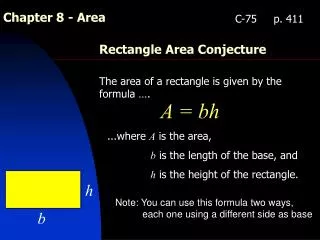
Theorem 10-1 Area of a RectangleTheorem 10-2 Area of a Parallelogram A base of a parallelogram is any of its sides. The corresponding altitude is a segment perpendicular to the line containing that base, drawn from the side opposite the base. The height is the length of an altitude.
Theorem 10-3 Area of a Triangle A base of a triangle is any of its sides. The corresponding height is the length of the altitude to the line containing that base.
Area Addition Postulate • The area of a region is the sum of the areas of its non-overlapping parts.
Example 1 Consecutive sides of the figure are perpendicular. Find the area of the total figure. Additional Question: If this was carpet, how much Would you pay if $4.00 sq. ft?
Example 2 Find the area of a square with diagonals length 8.
Example 3 Find the area of the triangles.
Example 4 • Find the area of the rhombus.