Gas Exchange
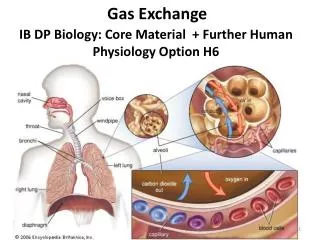
This comprehensive overview distinguishes between ventilation, gas exchange, and cell respiration. Ventilation involves inhaling and exhaling to facilitate oxygen intake and carbon dioxide expulsion. Gas exchange occurs in the alveoli and capillaries, where oxygen and carbon dioxide are swapped. It highlights the necessity of a ventilation system for living organisms to ensure adequate oxygen supply and maintain concentration gradients. Key features of alveoli that enhance gas exchange include moisture, a single cell layer for short diffusion distances, increased surface area, and a dense capillary network.

Gas Exchange
E N D
Presentation Transcript
Gas Exchange By: Jose Posada & Andrés González
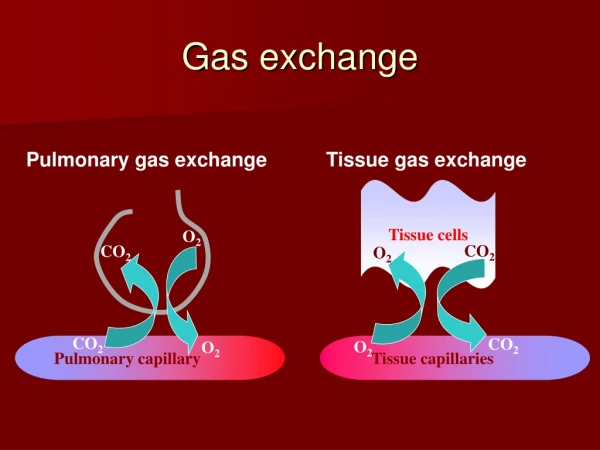
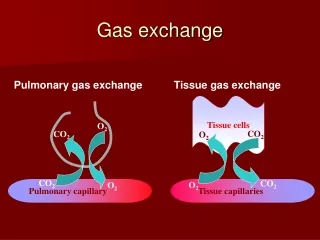
Distinguishbetweenventilation, gas exchange and cellrespiration • Ventilation: Is the process of inhaling and exhaling, with oxygen entering the alveoli (large surface area). • Cell Respiration: The chemical process occurring in the mitochondria where energy is released as ATP. • Gas exchange: Process of exchanging one gas for the other between the alveoli and capillaries. (Carbon dioxide for oxygen).
Explaintheneedfor a ventilationsystem • A ventilation system is needed in order to obtain oxygen for living organisms and to get rid of carbon dioxide. Surface diffusion utilized by many smaller organisms is not sufficient in supplying the oxygen needs of the body. It is also needed to maintain a concentration gradient in the alveoli.
Describe thefeatures of alveolithatadaptthemto gas exchange • Cells secrete fluid making the inner surface moist. • Single layer of cells allowing for short diffusion distance. • Increase in surface area. • Dense network of capillaries near the surface.
Mechanism of ventilation of thelungs Whenwe inhale Whenwe exhale Abdominalmuscles contract and the diaphragm becomes dome-shaped, moving up. The volume of the thorax decreases and intercostal muscles contract causing pressure to increase. Air flows out to equalize pressure gradient. • The diaphragm moves down and becomes flat because abdominal muscles relax(allowing for more air). The volume of the thorax increases, air flows into the lungs. External intercostal muscles contract.