Download
1 / 6
60 likes | 168 Vues
This guide covers the fundamentals of constructing electrical circuits, focusing on series and parallel configurations. Learn how to build a series circuit with a battery, light bulb, and switch, and a parallel circuit with a battery and two light bulbs. The guide also explains Ohm’s Law (V = I * R), demonstrating how to calculate current through a resistor. Using a resistance of 60 ohms connected to 12V, find the resulting current as an example. Enhance your knowledge of voltage measurement and circuit functionality.

E N D
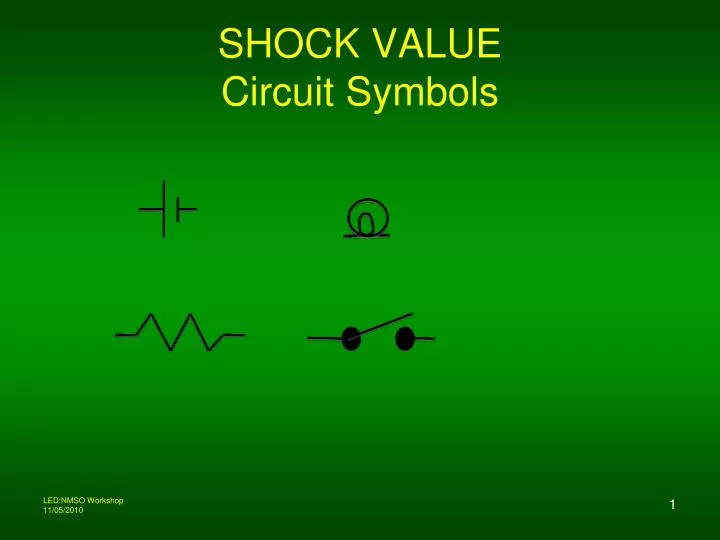
SHOCK VALUEConstructing Electrical Circuits • Construct a series circuit containing a battery, light bulb, and switch. • Construct a parallel circuit containing a battery, two light bulbs, and switch.
SHOCK VALUEOhm’s Law V = I R Potential difference: V volts Current: I amps Resistance: R ohms
SHOCK VALUEOhm’s Law Ohm’s law states that current is inversely proportional to resistance How much current flows through a lamp that has a resistance of 60 ohms when 12 V is connected across it? I = V/ R I = 12 V / 60 ohms = 0.2 amps