Download
1 / 58
580 likes | 708 Vues
Explore the fascinating relationship between waves, light, and energy where chemistry meets physics. From understanding what light is, to its interactions with matter, this guide delves into essential concepts such as wavelength, amplitude, and frequency. Discover how light changes matter and vice versa, as well as the practical uses of light in our daily lives. Get insight into Planck's constant and the photoelectric effect, highlighting the dual wave-particle nature of light. A valuable resource for students and enthusiasts alike, uncover the complexities of electromagnetic radiation and its significance.

E N D
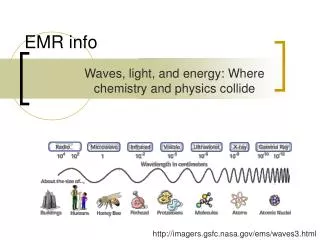
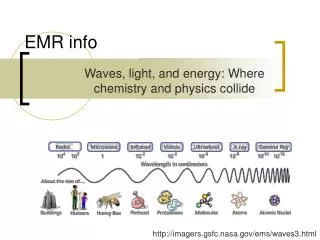
0 EMR info Waves, light, and energy: Where chemistry and physics collide http://imagers.gsfc.nasa.gov/ems/waves3.html
Before we get started…. • What is light? • Is it matter? • What forms of light exist? • List as many interactions of light and matter as you can. • think how light changes matter, and how matter changes light • What are some uses of light?
0 First things first: Waves a and b represent different wavelengths (λ)- the distance of a wave from crest to successive crest; measured in meters http://www.lbl.gov/MicroWorlds/ALSTool/EMSpec/EMSpec.html
Waves: amplitude 0 • The height of a wave from crest to midline or trough to midline; measured in meters
Terms you need to know: 0 • Wavelength (λ) • Amplitude • Frequency (ⱱ); I know some of you have used f, move on and get with chemistry! :) • the number of cycles (oscillations) per second • measured in cycles per second (s-1) or Hz (Hertz) • Waves on a string
0 http://www.lbl.gov/MicroWorlds/ALSTool/EMSpec/EMSpec2.html
0 http://micro.magnet.fsu.edu/primer/lightandcolor/images/electromagneticfigure1.jpg
0 http://lepus.physics.ualr.edu/~tahall/EXAM2/emspec.jpg
0 http://www.arpansa.gov.au/images/emsline2.gif
Visible Light • color wavelength(nm) ⱱ (*1014 Hz) Energy (*10-19 J) • Violet 400---460 7.5--6.5 5.0--4.3 • Indigo 460---475 6.5--6.3 4.3--4.2 • Blue 475---490 6.3--6.1 4.2--4.1 • Green 490---565 6.1--5.3 4.1--3.5 • Yellow 565---575 5.3--5.2 3.5--3.45 • Orange 575---600 5.2--5.0 3.45--3.3 • Red 600---800 5.0--3.7 3.3--2.5
Some equations you need to know 0 • λ= c / ⱱ and • E = hⱱ • So…. E = hc /λ • And… λ= h / mv* • When • λ = wavelength in m • c = speed of light, 3.00E8 m/s • ⱱ (nu)= frequency in Hz • (cycles/sec or s-1 or 1/s) • E= energy in J • h= Planck’s constant, 6.626E-34 J*s [Joule(seconds)] • m= mass of particle in kg • V*= velocity in m/s
What the h? Planck’s Constant 0 • When metals are heated, they glow • 1800s- physicists were trying to determine the relationship between the color (wavelength) and intensity of the glow • Max Planck (1900)- energy can be released or absorbed only in little chunks (packets) of energy “of some minimal size”
Max Planck and the h 0 • The chunks of energy were dubbed “quantum” (“fixed amount”), which is the smallest amount that can be emitted or absorbed as EMR. • Proposed: E = hⱱ • The energy (E) of a single quantum is equal to its frequency (ν) times a constant
Planck and the Nobel (Physics) 0 • Planck determined that h= 6.626E-34 J-s • Energy is always released in multiples of hv (1hv, 2hv, 3hv, etc) • h is so small that we cannot see the effects of this in our daily lives • Analogous to… • Planck won the 1918 Nobel Prize in physics for his work
Einstein & Bohr: Perfect Together 0 Einstein, left Bohr, above
Einstein:The Photoelectric Effect 0 • Einstein discovered that one could cause electrons to be ejected from the surface of a metal if the energy of the light wave was strong enough • He treated the light needed to do this as a piece of matter- a photon, if you will • This ejection of e- is the photoelectric effect
The Photoelectric Effect 0 • Only light of a certain energy could knock off an electron from the metal • Intense light of a weaker wavelength would not work, but even a low intensity of the correct wavelength would work • (the energy of the light is transferred to the kinetic energy of the electron) • Hmmm… light acting as a particle and as a wave…..
The photoelectric effect… 0 • Online animations • PhET • http://www.lewport.wnyric.org/mgagnon/Photoelectric_Effect/photoelectriceffect1.htm • http://www.xmission.com/~locutus/applets/Photoelectric.html
Getting to Bohr…. 0 • Light of a given wavelength is monochromatic (one color) • Most common EMR sources are polychromatic, but we see only one color • These can be reduced to a spectrum when the different wavelengths are separated out
Spectral Emissions 0 • Continuous spectrum: shows all colors of the rainbow
0 • Bright line spectrum: only certain wavelengths are visible (the rest do not appear at all) • Different elements have different bright line spectrum when they are heated • Na is yellow • Ne is orange-red
Line spectrum 0 • Ne • I2
0 http://www.cartage.org.lb/en/themes/Sciences/Astronomy/Modenastronomy/Interactionoflight/AtomicAbsorption/AtomicAbsorption.htm
Hydrogen Spectra 0 Emission Spectra Absorption Spectra http://www.mhhe.com/physsci/astronomy/applets/Bohr/content_files/section1.html
0 http://www.cartage.org.lb/en/themes/Sciences/Astronomy/Modenastronomy/Interactionoflight/AtomicAbsorption/AtomicAbsorption.htm
Color and what you see: • Absorption: the wavelengths that are absorbed by an object are not available for us to see, as we see the wavelengths of light that are reflected off of an object • This is not the same as those wavelengths that are emitted by an object that is emitting radiant energy.
0 • Line spectra formation- go to….. http://www.mhhe.com/physsci/chemistry/essentialchemistry/flash/linesp16.swf • http://www.mhhe.com/physsci/chemistry/animations/chang_7e_esp/pem1s3_1.swf
Bohr Model and Spectral Emissions 0 • Bohr proposed that the emission of light energy from an (electrically or thermally) excited atom corresponds to the orbit of the electron around the nucleus of the atom • That energy can only be achieved by being a specific distance from the nucleus
What you’ve seen so far…. 0 Model of an Iodine atom (atomic number =53)
Bohr Model and moving electrons 0 • http://www.colorado.edu/physics/2000/quantumzone/bohr.html
Energy levels- Bohr Model 0 • Electrons travel within set energy levels that have a particular energy associated with each level • After all, the e-s are moving around the nucleus • think KE here • Each shell has a number • Closest to the nucleus is n=1 • For each successive level add 1 to n • n=2, n=3, ect….
Energy increases as the distance from the nucleus increases 0
Bohr Model and moving electrons 0 • http://www.colorado.edu/physics/2000/quantumzone/bohr.html
SO… 0 • We know that the e-’s are free to move around the nucleus • They also can move from one energy level to the next (and fall) back when energy is added • Move from ground state (“home” level) to a higher level (the “excited” state) • Returning back to the ground state releases energy
0 • This emission is how we see colors: • the wavelengths of EMR released from an atom when it has been excited by • Heat energy • Electrical energy • Chemical energy • Think glowing red hot metal, or fireworks
Determining Energy for n • To determine the energy for a given energy level, use the equation: • En=(-RH)(Z/n2) • RH = 2.18E-18J, • Z= the atomic number of the atom • n=1, 2, 3, 4…. • So En=(-2.18E-18J)(Z/n2)
To determine E emitted or absorbed: • To determine the change in energy for a given energy transition: • ΔE=Ef-Ei • *Remember E=hⱱ, so ΔE=hⱱ • so ΔE=[(-2.18E-18J)(Z/n2)]f- [(-2.18E-18J)(Z/n2)]i • Remember that + values mean E that is absorbed, and – values mean released
E changes continued • *Remember E=hν, so ΔE=hⱱ to get the frequency of the light emitted or absorbed • If ΔE is positive • since Ef>Ei • E is absorbed • The e- was going from ground state to an excited state • If ΔE is negative • since Ef < Ei • E is released • The e- was going to ground state from an excited state
To determine E emitted or absorbed: • What is the change in energy associated with an electron dropping from n=5 to n=1 in a Hydrogen atom? • ΔE=Ef-Ei • so ΔE=[(-2.18E-18J)(Z/n2)]f- [(-2.18E-18J)(Z/n2)]i • ΔE=[(-2.18E-18J)(1/12)]f- [(-2.18E-18J)(1/52)]I • ΔE = -2.09E-18 J • Which means 2.09E-18J are released • Makes sense; an e- is dropping from 5 to1, E is released when e- drop
Back to basics EMR calcs… • That released Energy can be used to determine the wavelength and frequency of the EMR emitted. • Remember that you need to treat the energy as positive to do this! • The sign only gives direction of energy flow • There is no negative energy, only energy leaving • If you used – energy, you’d get a - or -ⱱ • This isn’t possible!
Also…life after Einstein and Bohr 0 • We know that electrons have characteristics of both light (waves) and matter, so we say that they have a dual nature
De Broglie 0 • De Broglie proposed that an electron moving about the nucleus had a wave-like behavior, so it has a particular wavelength associated with it. This wavelength depends upon the mass and velocity of the electron. • = h / mv • mv = the momentum of the particle • Mass* velocity = p • momentum = p so p = mv • therefore = h / p