Understanding Area Formulas for Shapes: Rectangle, Square, Triangle, and More
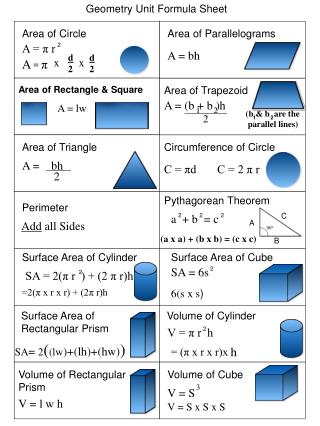
In this unit, we explore the formulas used to calculate the area of various geometric shapes, including rectangles, squares, triangles, pentagons, and hexagons. Discover how the area of a rectangle is calculated as the length of the base multiplied by the height, while a square's area is derived from the base length squared. Triangle area calculations involve multiplying the base length by the height and dividing by two. Learn how parallelograms share a formula with rectangles, and grasp the distinctions between triangles and parallelograms. Dive into geometry now!

Understanding Area Formulas for Shapes: Rectangle, Square, Triangle, and More
E N D
Presentation Transcript
Unit 8:Formula By: Grace Silverstein, and Samantha Stoeber!
Using the Formula to Calculate the Area TRY THIS! Figure out the “formula” for a pentagon. What about a hexagon? • The “formula” to calculating the area is different for some shapes. Rectangle and Parallelogram Length of base multiplied by height is equal to the area of a rectangle!* Square Length of Base multiplied by itself is equal to the area of a square! Triangle Length of base multiplied by the height divided by 2 is equal to the area of a triangle! *Notice: The formula is the same for calculating the area of rectangles and parallelograms!*
The Difference between Parallelograms and Triangles Tri angles Parallelograms • Have 3 sides • Have 3 angles • Have 3 vertices • Have their own formula! • Have 4 sides • Have 4 angles • Have 4 vertices • Share a formula with rectangles!