SlideServe
Menu
Préférences
© SlideServe · v2026

Ancient Astronomy: Planets, Motion, and Models

vkearney avatar
18 diapositives · 219 Views · Jan 08, 2020

Explore ancient astronomers' understanding of planets' motion, known planets, and geocentric models. Learn about Ptolemy's Almagest and arguments for a geocentric universe. Discover the complexity of celestial spheres and retrograde motion.
Ancient Astronomy: Planets, Motion, and Models - slide 1
01 / 18Ancient Astronomy: Planets, Motion, and Models
1 / 17

Télécharger la présentation

Ancient Astronomy: Planets, Motion, and Models
Une image / un lien ci-dessous est fourni (tel quel) pour télécharger la présentation

Politique de téléchargement : le contenu du site vous est fourni TEL QUEL pour votre information et votre usage personnel ; il ne peut être vendu, concédé sous licence ni partagé sur d’autres sites sans l’accord de son auteur.Le contenu vous est fourni TEL QUEL, pour votre information et votre usage personnel uniquement. Téléchargez la présentation en cliquant sur ce lien. Lors du téléchargement, si vous ne parvenez pas à télécharger une présentation, l’éditeur a peut-être supprimé le fichier de son serveur.Pendant le téléchargement, si vous ne parvenez pas à obtenir une présentation, le fichier a peut-être été supprimé par l’éditeur.

F I N

Plus de contenu associé

Transcription de la présentation
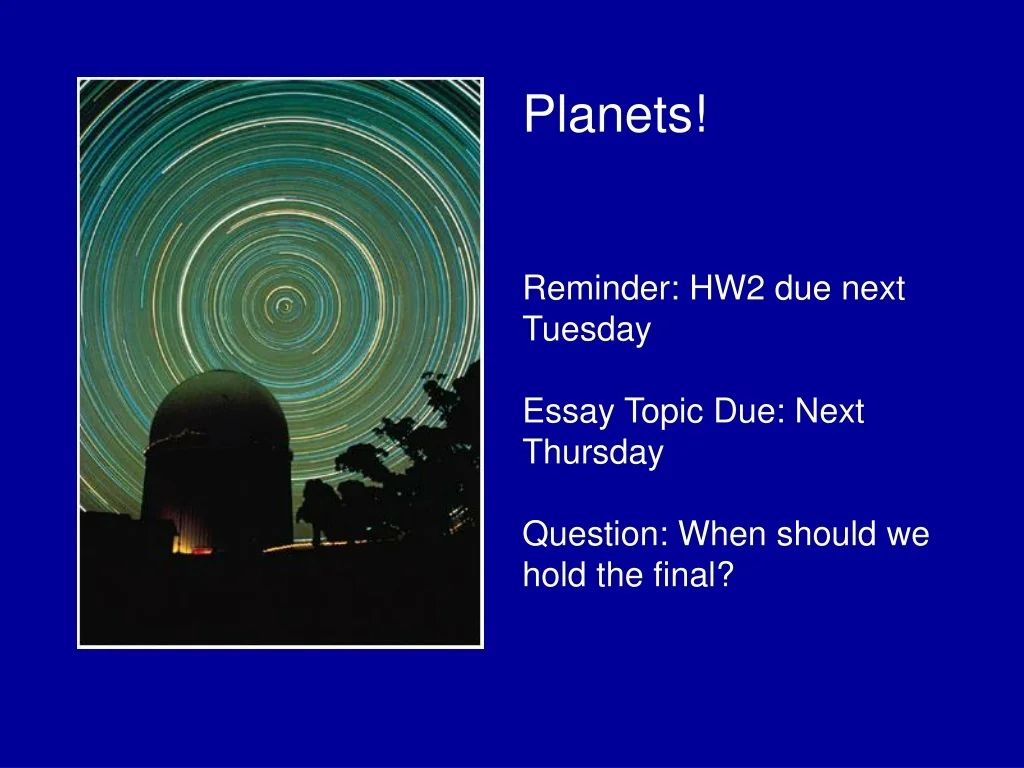
  1. Planets! Reminder: HW2 due next Tuesday Essay Topic Due: Next Thursday Question: When should we hold the final?

  2. Alert! A total lunar eclipse will be visible over Arizona skies on February 20, 2008.  It will take place just before sunset in North America and much of the western hemisphere.  The full moon will pass into the shadow of the earth and be visible over Tucson skies at 6:48 p.m.  Sky gazers should look to the eastern horizon.

  3. SIZE OF THE EARTH l = Distance from Alexandria to Syene D = Circumference of the Earth l = (7.2/360)*D l = 5000 stades D=(360/7.2)*l D=250,000 stades 1 stade = 157 meters (a Greek stadium at, for example, Olympia) D=157*250000 meters D=39,250,000 meters D = 39,250 kilometers Modern Value = 40,070 kilometers

  4. Planets known to the Ancients • Mercury (Hermes), dim and close to the horizon, Mercury is difficult to see. He moves quickly across the sky. Messenger of the gods. • Venus (Aphrodite), the morning and evening star, very bright but variable, goddess of love. • Mars (Ares), the red planet, god of war. • Jupiter (Zeus), very bright, king of the gods. • Saturn (Kronos), bright and pale yellow, first of the Titan’s, father of Zeus.

  5. Motion of the Planets • The most difficult challenge facing ancient astronomers was explaining the motion of the planets. The word “planet” derives from the Greek “planetes,” which means wanderer. Planets move in the sky relative to stars. They also vary in brightness and, on occasion, even change direction. This is known as retrograde motion.

  6. Image of the Sky

  7. Planets, Sun, Moon are close to a Great Circle - the Ecliptic Saturn Venus Jupiter Mercury Sun (just set)

  8. The Celestial Sphere Figure from Astronomy: from the Earth to the Universe by Pasachoff

  9. Apparent motion of the Sun

  10. The seasons are caused by the tilt of the Earth. From Astronomy: from the Earth to the Universe by Pasachoff Earth is tilted 23.5º from the plane of the solar system

  11. Retrograde Motion The Movie

  12. How do we explain all this?

  13. Ptolemy (85-150 AD) lived in Alexandria, Egypt, where he wrote The Almagest , which recorded a sophisticated system for describing the motion of celestial bodies. Learning in the Greek/Roman world declined in the centuries after Ptolemy, but was kept alive in the Muslim world. Almagest means “greatest” in Arabic.

  14. Ptolemy’s Geocentric System, codified in the Almagest Figures from Astronomy Today by Chaisson and McMillan This is getting complicated.

  15. Arguments for a Geocentric Universe • If the Earth were moving, we would have a sense of motion. There is no sensation of motion; therefore, the Earth is not moving. • We don’t fall off as the Earth speeds ahead. • The apparent positions of the stars do not change, i.e. we see no parallax. • The Earth is an important place and it is natural that it is at the center of the Universe.

  16. Ptolemy’s Own Defense • Ptolemy’s model can be criticized on the grounds that it is cumbersome and lacking in beauty and symmetry. • “Let no one, seeing the difficulty of our devices, find troublesome such hypotheses. For it is not proper to apply human things to divine things from such dissimilar examples.” • Translation: What seems complicated to humans may seem simple to the gods.

  17. Summary and a Look Ahead • The concept of Celestial Spheres allows us to predict the motion of the stars. • If we add epicycles and several other “fixes” it is possible to predict the motion of the planets. • Ptolemy’s geocentric model provided the most accurate predictions of celestial motion. It allowed people to navigate to distant parts. • The geocentric model is cumbersome and inelegant. The symmetry that so drove the ancient Greeks has been lost. Is there an alternate, simpler model, that can explain the observations?

  18. Layout of the Solar System From Astronomy: from the Earth to the Universe by Pasachoff