Sample Return from C-Type Asteroids: Insights for Understanding Earth's Early History
200 likes | 322 Vues
This presentation explores the significance of C-type asteroids, which are remnants from the early solar system. We discuss sample return missions like JAXA's Hayabusa2 and NASA's OSIRIS-REx, highlighting their potential to provide vital information about water, organics, and the formation of terrestrial planets. Understanding these samples will enhance our knowledge of the solar system’s history, including the origins of life. We also consider meteorite studies and the techniques needed to analyze these extraterrestrial materials to unlock their secrets.


Sample Return from C-Type Asteroids: Insights for Understanding Earth's Early History
E N D
Presentation Transcript
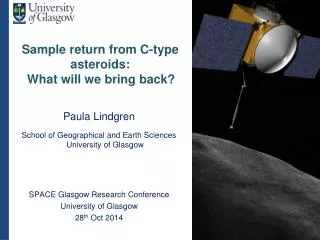
Sample return from C-type asteroids: What will we bring back? • Paula Lindgren • School of Geographical and Earth Sciences University of Glasgow • SPACE Glasgow ResearchConference • University of Glasgow • 28th Oct 2014
Asteroids Leftovers from the building blocks of our solar system A few meters to several hundreds of kilometres wide • The Asteroid belt • The Kuiper belt • Near Earth Objects • Trojans, Hildas, Greeks
Remote space exploration Asteroid Lutetia, ESA Rosetta mission 10 July 2010 • Ground-based telescopes from Earth • Flyby missions • Spectral data, imaging • Reflects mostly the surface composition • No hands-on samples • Rosetta Mission • COSIMA Cometary Secondary Ion Mass Analyzer • Landing on comet 12th Nov 2014 Comet 67P/Churyumov-Gerasimenko ESA Rosetta mission, 14 Sep 2014
Extraterrestrial sample return JAXA Hayabusa Itokawa S-type asteroid launch 2003 – return 2010
Sample return from C-type asteroids • JAXA Hayabusa2 • NASA OSIRIS REx • Earliest history of water and organics
JAXA Hayabusa 2 • Asteroid 1999 JU3 • Explosive device to dig surface • CM1-CM2 carbonaceous chondrite • Launch December 2014 - return 2020’s?
NASA OSIRIS-REx • Asteroid Bennu • C-type asteroid (sub-type B) • CM1 carbonaceous chondrite • 0.055% chance of colliding with Earth in 2082 • Launch 2016 - return 2020’s
Sample return from C-type asteroids • The only samples of C-type asteroids currently available are from meteorites To understand and make scientific use of the samples that will be returned in future missions, we need a good knowledge of the properties of the meteorite samples we have at hand today.
Meteorites • Asteroids, Mars and the Moon • Hands-on samples • Composition and structure of asteroidal interiors • Which asteroid? • Where within the asteroid? • Heating during atmospheric entry • Terrestrial weathering (Antarctica, hot deserts, museums)
Carbonaceous chondrites Solar nebula Carbonaceous chondrites Accretion PRIMITIVE METEORITES Ordinary chondrites Primitive asteroids Enstatitechondrites Melting Differentiation Stones (achondrites) Evolved asteroids/planets EVOLVED METEORITES Stony irons Irons
Carbonaceous chondrites Archives for early solar system processes: • Accretion and compaction • First solids: CAIs and chondrules • Carbon bearing organic molecules:building blocks for life • Traces of first water in Solar System (CM, CI) 20 µm 40 µm
Products formed from alteration by water Secondary mineralogy • Phyllosilicates (e.g. serpentine, saponite) • Hydroxysulphides (e.g. tochilinite) • Carbonates (aragonite, calcite, dolomite, siderite, breunnerite) • Sulphates (gypsum, epsomite) • Iron oxides (magnetite) • Sulphides (pyrrhotite, pentlandite) • Halides (halite, sylvite)
SEM imaging and microanalyses Calcite grains 10 μm 60 μm
Time scale liquid H2O • When did liquid H2O first form? • For how long time was liquid H2O present?
Time scale liquid H2O 55Mn- 53Cr dating of carbonates • Solar system had an initial ratio of 53Mn/55Mn (9.1 ± 1.7 × 10⁻⁶, Nyqvist et al. 2009) • 53Mn decays to 53Cr with a very short half-life of 3.7 million years (extinct today) • Measuring excess 53Cr in carbonate → determine the initial 53Mn/55Mn of the carbonate → time from accretion 4.568 billion years ago to the precipitation of the carbonate
Time scale liquid H2O Mn-Cr dating of carbonates CamecaNanoSIMS 50L; Carnegie Institutions Washington
Time scale liquid H2O Mn-Cr dating of single-phase carbonates: a ‘snapshot’ in time of aqueous alteration Dolomite grain free of inclusions Si Kα 30 μm
Time scale liquid H2O Mn-Cr dating • 9 dolomite grains free of inclusions • 53Mn/55Mn ratio: 4.37x10⁻⁶±1.9x10⁻⁷ (2σ) • Crystallisation age: 3.93 ± 1.7 Ma
Time scale liquid H2O • Liquid H2Opresent within ~4 Ma after accretion(Mn-Cr dating) • Duration?Dating alteration products replacingcarbonates 30 μm calcite Phyllosilicate replacing carbonate in LAP 031166 (CM2)
Acknowledgements • Martin Lee and MahmoodSofe, University of Glasgow • Darren Mark and Ben Cohen, SUERC, Glasgow • Conel Alexander, Carnegie Institutions, Washington DC • UK-STFC for funding • NASA Antarctic meteorite collection for loan of meteorites • Thank you for your attention!