Download
1 / 9
100 likes | 234 Vues
Explore the fundamentals of electric circuits, including series and parallel configurations, power calculations, and safety protocols. Circuit diagrams effectively illustrate the flow of charge and components like switches, bulbs, and current sources. In series circuits, a single path carries the charge, while parallel circuits offer multiple paths, ensuring functionality even if one component fails. Learn about electric power (measured in watts), and discover important safety measures for households, such as fuses and circuit breakers, to prevent electrical hazards.

E N D
Electric Circuits Series and Parallel Circuits
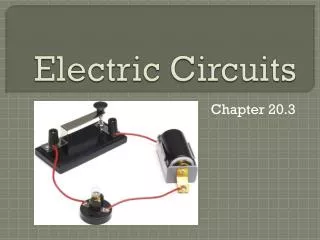
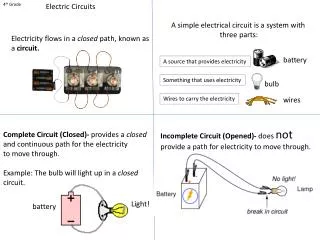
Circuit Diagrams • An electric circuit is a complete path through which charge can flow • Circuit diagrams use symbols to represent parts of a circuit • Circuit diagrams show a source of electrical energy, and devices run by electrical energy
Circuit Diagrams • A circuit diagram will show one or more paths for the charge to flow • Switches are where the circuit can be open • An open circuit occurs if a switch is open then the circuit is not a complete loop and the current stops • A closed circuit is when the switch is closed and the circuit is complete
Series Circuit • A series circuit has only one path that the charge can flow • If one element in a series circuit stops working then the whole circuit will not work • Each bulb in a series circuit adds resistance and makes all of the bulbs dimmer
Parallel Circuit • A parallel circuit is when two or more paths through which the charge can flow • If one element stops working then the charge can flow along another path • This is common in houses
Power and Energy • The rate at which electrical energy is converted to another form of energy is electric power • The unit is joule per second or watt (W) • Power is often in kilowatts (kW) • Power = current x voltage or P = I x V • P(watts) = I (amps) x V (volts)
Example • An electric oven is connected to a 240 volt line and it uses 34 amps of current. What is the power used by the oven? • Current = I = 34 ampsVoltage = V = 240 voltsPower = I x V • Power = 34 amps x 240 voltsPower = 8160 watts
Electrical Safety • There are several things needed to make a house safe such as correct wiring, fuses, circuit breakers, insulation, and grounded plugs • In the US most houses have an average of 120 volts and each device increases the current • If too many devices are used it may cause a fire
Home Safety • A fuse prevents current overload in a circuit • A wire in the fuse will melt if there is too much current • This is how we “blow a fuse” • Most houses now use circuit breakers • A circuit breaker is a switch that will open when a current is too high