Understanding Remote Method Invocation (RMI) in Java: A Comprehensive Guide
This guide explores the concept of Remote Method Invocation (RMI) in Java, detailing its architecture, including the roles of clients and servers. It covers the registration process with the RMI registry and the creation of service interfaces that define remotely invokable methods. You will learn about implementing RMI service interfaces and generating stub and skeleton classes using the rmic tool. Additionally, this guide provides insights into creating RMI clients and servers, as well as running the overall RMI system for seamless remote communication.

Understanding Remote Method Invocation (RMI) in Java: A Comprehensive Guide
E N D
Presentation Transcript
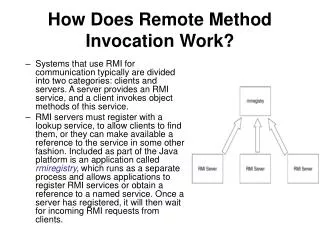
How Does Remote Method Invocation Work? • Systems that use RMI for communication typically are divided into two categories: clients and servers. A server provides an RMI service, and a client invokes object methods of this service. • RMI servers must register with a lookup service, to allow clients to find them, or they can make available a reference to the service in some other fashion. Included as part of the Java platform is an application called rmiregistry, which runs as a separate process and allows applications to register RMI services or obtain a reference to a named service. Once a server has registered, it will then wait for incoming RMI requests from clients.
Defining an RMI Service Interface • Any system that uses RMI will use a service interface. The service interface defines the object methods that can be invoked remotely, and specifies parameters, return types, and exceptions that may be thrown. Stub and skeleton objects, as well as the RMI service, will implement this interface. • Ex: public interface RMILightBulb extends java.rmi.Remote { public void on () throws java.rmi.RemoteException; public void off() throws java.rmi.RemoteException; public boolean isOn() throws java.rmi.RemoteException; }
Implementing an RMI Service Interface • Once a service interface is defined, the next step is to implement it. This implementation will provide the functionality for each of the methods, and may also define additional methods. However, only those methods defined by the RMI service interface will be accessible remotely, even if they are marked public in scope or as being able to throw a RemoteException.
Creating Stub and Skeleton Classes • The stub and skeleton classes are responsible for dispatching and processing RMI requests. Developers should not write these classes, however. Once a service implementation exists, the rmic tool, which ships with the JDK, should be used to create them. • The implementation and interface should be compiled, and then the following typed at the command line: rmic implementation
Creating an RMI Server • Creating an RMI Client • Running the RMI System • Remote Method Invocation Packages and Classes