Viscosity Presentation By Team Eight
80 likes | 202 Vues
In this presentation, we explore how to measure the viscosity of liquids by observing the behavior of spheres as they fall through different fluids. By analyzing the time it takes for steel and glass marbles to traverse a known distance in various liquids like motor oil (10W-30), we can calculate viscosity. Faster falls indicate lower viscosity, while slower falls indicate higher viscosity. This hands-on experiment employs simple materials and formulas, along with engaging resources to enhance understanding of fluid dynamics.


Viscosity Presentation By Team Eight
E N D
Presentation Transcript
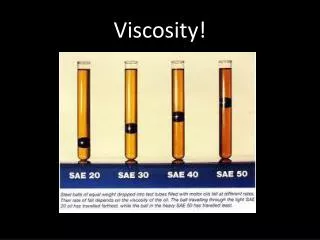
Objective • To determine how fluid a liquid really is by measuring its viscosity. • We will simply see how fast a sphere falls through a fluid. The faster the sphere falls, the lower the viscosity. The slower the sphere falls, the higher the viscosity.
Material List / Price List • Materials • Marbles (steel and glass) -$1.00 • Motor oil (10W-30) -$2.00 • Graduated cylinder -$5.00 • Calculator-$15.00 • Stopwatch -$4.00 • Ruler -$1.00 • Thermometer-$15.00
Method • The measurement involves determining the velocity of the falling sphere. This is accomplished by dropping each sphere through a measured distance of fluid and measuring how long it takes to traverse the distance. Thus, you know distance and time, so you also know velocity, which is distance/time. • The formula for determining the viscosity is decorated with Greek letters and a squared term, but simply amounts to multiplying some numbers and then dividing by some others: • delta p = difference in density between the sphere and the liquid • g = acceleration of gravity • a = radius of sphere • v = velocity = d/t = (distance sphere falls)/(time of it takes to fall)
UsefulTables • 100 Centipoise = 1 Poise 1 Centipoise = 1 mPa s (Millipascal Second) • 1 Poise = 0.1 Pa s (Pascal Second)
Resources • Interactive Model • http://www.nasaexplores.com/index.php • http://www.vp-scientific.com/Viscosity_Tables.htm • http://www.spacegrant.hawaii.edu/class_acts/ViscosityTe.html • Cornell University Model