Creating Polynomials from Given Zeros: Understanding the Process
This guide delves into the creation of polynomial functions based on their zeros, discussing the properties of polynomial functions including their odd and even nature. We explore the methods for finding zeros through factoring, long division, and various formulas. Learn how to write polynomial functions of least degree with rational coefficients using given zeros, step-by-step factoring, and multiplication. The guide also highlights the significance of real, rational, and imaginary solutions while reinforcing the concept of pairing in imaginary zeros.


Creating Polynomials from Given Zeros: Understanding the Process
E N D
Presentation Transcript
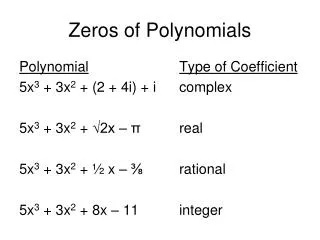
What do we already know about polynomial functions? They are either ODD functions They are either EVEN functions Linear y = 4x - 5 Cubic y = 4x3 - 5 Quadratics y = 4x2 - 5 Quadratics y = 4x2 - 5 Fifth Power y = 4x5 –x + 5 Quartics y = 4x4 - 5
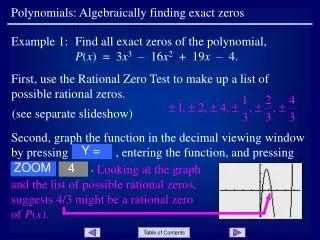
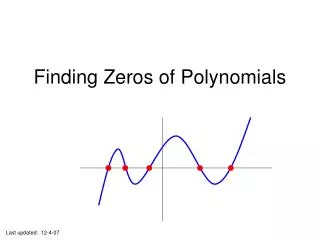
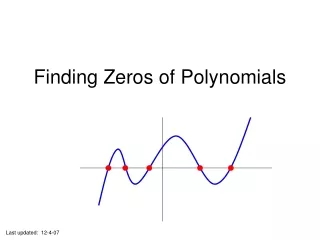
We know that factoring and then solving those factors set equal to zero allows us to find possible x intercepts. TOOLS WE’VE USED Long Division (works on all factors of any degree) Factoring GCF Quadratic Formula (x + )(x + ) Synthetic Division (works only with factors of degree 1) The “6” step Grouping Cubic** p/q
We know that solutions of polynomial functions can be rational, irrational or imaginary. X intercepts are real. Zeros are x-intercepts if they are real Zeros are solutions that let the polynomial equal 0
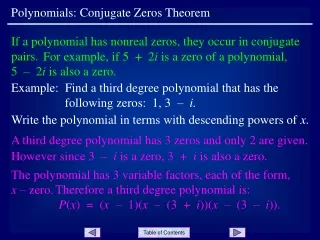
We have seen that imaginaries and square roots come in pairs ( + or -). So we could CREATE a polynomial if we were given the polynomial’s zeros.
Write a polynomial function f of least degree that has rational coefficients, a leading coefficient of 1 and the given zeros. -1, 2, 4 Step 1: Turn the zeros into factors. (x+1)(x- 2)(x- 4) Step 2: Multiply the factors together. f(x) =x3 - 5x2 +2x + 8 x3 - 5x2 +2x + 8 Step 3: Name it!
Write a polynomial function f of least degree that has rational coefficients, a leading coefficient of 1 and the given zeros. Step 1: Turn the zeros into factors. Must remember that “i”s and roots come in pairs. Step 2: Multiply factors.
Write a polynomial function f of least degree that has rational coefficients, a leading coefficient of 1 and the given zeros. Step 1: Turn the zeros into factors. Must remember that “i”s and roots come in pairs. Step 2: Multiply factors.
x 2 i x -2 x x x 2 -i x2 -2x x2 ix 2x x -2 x 4 x 2i 2x -2x 4 x x x x -ix -2i 1 -i2 -3 (x2- 4x + 1) (x2+ 4x + 5)
x2+ 4x + 5 x2 -4x 1 4x3 x4 5x2 -20x -4x3 -16x2 4x 5 x2 f(x) = x4-10x2 -16x + 5 -3