Understanding Employer-Sponsored Educational Assistance Plans: Benefits and Tax Implications
Educational assistance plans help employers reimburse employees for educational expenses, including job-related training and non-job-related programs. These plans can enhance employee skills and job satisfaction while providing tax advantages for both employers and employees. However, there are limits, and care must be taken with broader programs to prevent employees from being trained for other jobs. Tax implications exist; deductions are allowed under certain conditions. This document outlines the features, advantages, and requirements of such plans, including ERISA compliance.

Understanding Employer-Sponsored Educational Assistance Plans: Benefits and Tax Implications
E N D
Presentation Transcript
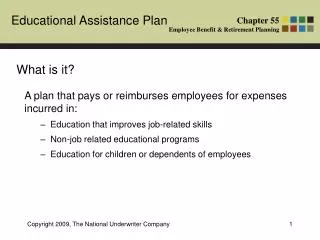
What is it? A plan that pays or reimburses employees for expenses incurred in: • Education that improves job-related skills • Non-job related educational programs • Education for children or dependents of employees
Advantages • Employers benefit when employees gain skills through education • Properly structured job-related educational benefits are not taxable income to employees
Disadvantages • Broad program may simply train employee for job with another employer • Educational benefits beyond certain limits are taxable as compensation to the employee
Tax Implications • Individual can deduct job-related educational expenses IF education: • Maintains or improves skill required in individual’s employment • Is expressly required by individual’s employer as condition of keeping the individual's job Other types of education are not deductible
Tax Implications • Travel expenses not deductible as job-related educational expenses • Employer reimbursements to employees for job-related educational expenses are deductible by employer as compensation • Plan can be designed in such a way that it is tax- free
Tax Implications • Tax benefits exist for those incurring educational expenses: • Itemize deduction as employee business expense • Tuition and fees at eligible post-secondary education institution are deductible even if do not itemize • Hope Scholarship and Lifetime Learning tax credits
Tax Implications • IRS sets specific criteria for “qualified educational assistance plans”; currently, broad range of educational reimbursements allowed on tax-free basis • Employer reimbursements for education of employee’s children or dependents are: • Taxable income to employee • Deductible as compensation by employer
ERISA Requirements Educational assistance plans may be considered welfare plans under ERISA: • Written plan • Written claims procedure • Summary plan description furnished to employees Funded plans face additional rules
How to Install a Plan • Write plan • Draft and distribute Summary Plan Document in accord with ERISA requirements • No government approval required
Discussion Question How is an “educational benefit trust” used?