Enhancing Policymaking Through Context Assessment and Effective Communication Strategies
This document outlines specific tools for engaging policymakers by assessing political contexts and mapping policy processes. It introduces a Political Context Assessment Tool to evaluate macro political environments, stakeholders, and decisive moments in policy practice. Also included are case studies illustrating policy changes, as well as workshops promoting participatory approaches to evaluate internal processes. Furthermore, guidance on writing effective policy papers is provided, focusing on problem descriptions, policy options, and clear communication strategies to ensure impactful messaging for diverse audiences.

Enhancing Policymaking Through Context Assessment and Effective Communication Strategies
E N D
Presentation Transcript
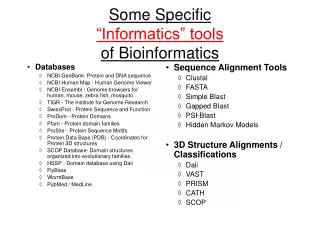
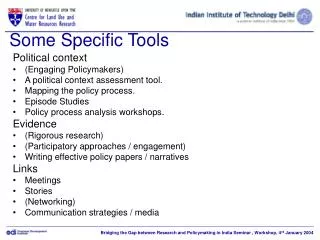
Some Specific Tools Political context • (Engaging Policymakers) • A political context assessment tool. • Mapping the policy process. • Episode Studies • Policy process analysis workshops. Evidence • (Rigorous research) • (Participatory approaches / engagement) • Writing effective policy papers / narratives Links • Meetings • Stories • (Networking) • Communication strategies / media
Political Context Assessment Tool A simple tool to assess: • The macro political context • The sector / issue process • Policy implementation and practice • Decisive moments in the policy process • How policymakers think
Mapping the Policy Process • General Context issues – domestic and international. • Specific Policy Issues (i.e. the policy cycle) • Who are the Stakeholders? (Stakeholder analysis) • Arena: government, parliament, civil society, judiciary, private sector. • Level: local, national, international • Process matrix + political influence ratings • What is their Interest and Influence? [Sources: M. Grindle / J. Court ]
Episode Studies Look at a clear episode of policy change, assess the issues that influenced it and the relative role of research. Examples include: • The Adoption of PRSPs • Community-based Animal Health in Kenya • Sustainable Livelihoods in DFID • Principles in Humanitarian Response More at: www.odi.org.uk/RAPID/
Policy process workshops (eg DFID) • Looking at internal policy processes – what works in DFID. • Small, informal workshop with 7 staff. • Participatory pair-wise ranking of factors influencing the success of 8 policy processes. • Worked quite well. • In DFID - agendas and processes rather than documents are key
Writing Effective Policy Papers I Providing a solution to a policy problem The policy community • The policy process • Structural elements of a paper • Problem description • Policy options • Conclusion • Key issues: Problem oriented, targeted, multidisciplinary, applied, clear, jargon-free. [Source: Young and Quinn, 2002]
Writing Effective Policy Papers II Criteria for Assessing Policy Options
Meetings • Does evidence matter –Halpern, Millstone • The political context –Cable, Court • The role of research –Spray, Young • NGO campaigns –Forsyth, Simms • Think-tanks –Bentley, Maxwell, Garnett • Using knowledge effectively –Cheuk, Borton • Policy entrepreneurship –Maxwell, Pettifor • International policies –Desai, Wilks More at: www.odi.org.uk/RAPID/Meetings
Stories These can be very effective. Examples from ODI/GDN work include: • Joint Forestry Management • Participatory Ecorestoration - AHADS • DELIVERI – Indonesia • Water Management in India More at: www.odi.org.uk/RAPID/
Communications strategy • Identify the message(s) • Identify the audience(s) • Assess specific information needs, likes and channels • Official / unofficial • Personal / impersonal • Develop and test material and media • Printed, AV, web, CD • Multi-use, multimedia, multichannel • Evaluate impact and change as necessary