Simplifying Rational and Radical Expressions: Factorization and Domain Analysis
120 likes | 253 Vues
This resource guides students on finding the domain of rational and radical expressions by mastering the concept of factoring through the greatest common factor (GCF). Students will learn how to identify and factor expressions, as well as determine the set of x-values that yield real numbers for given functions. Various examples and practice problems are provided, including factoring expressions as well as determining domains of functions. This comprehensive approach ensures a solid understanding of key algebraic concepts.


Simplifying Rational and Radical Expressions: Factorization and Domain Analysis
E N D
Presentation Transcript
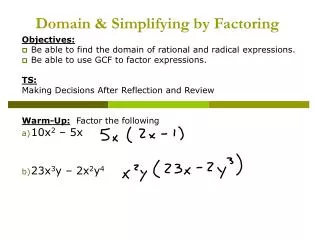
Domain & Simplifying by Factoring Objectives: Be able to find the domain of rational and radical expressions. Be able to use GCF to factor expressions. TS: Making Decisions After Reflection and Review Warm-Up: Factor the following 10x2 – 5x 23x3y – 2x2y4
So in order to factor out a GCF all you need to do is… • Factor out the greatest numerical value • Identify all common variables or expressions • Factor out the smaller variable amount by subtracting the smaller power from the larger
Finding the Domain of a Function The domain of a function is the set of x-values when plugged into a function give a real number. Example: For the domain is [2, ∞) For the domain is (-∞, 0) U (0, ∞)