Understanding Logarithms: Exponential Growth, Properties, and Applications
This comprehensive guide delves into the fundamentals of logarithms and their application in exponential growth scenarios, such as doubling money over time. Through various examples, readers will learn how to manipulate logarithmic and exponential equations, utilize logarithmic properties, and convert expressions between logarithmic and exponential forms. Key concepts include identifying the domain of logarithmic functions and rewriting equations for greater clarity. This resource aims to build a solid foundation in logarithms for practical financial and mathematical applications.

Understanding Logarithms: Exponential Growth, Properties, and Applications
E N D
Presentation Transcript
Logarithms The “I’m going to lie to you a bit” version
Example • Every year I double my money $1 $1 $1 $1 $1 $1 $1 $1 $1 $1 $1 $1 $1 $1 $1 Year 0 Year 1 Year 2 Year 3
Example • If I know what time it is and want to know how much money I have $1 a=1(2t) a=# of $ t=# of yrs $1 $1 $1 $1 $1 $1 $1 $1 $1 $1 $1 $1 $1 $1 Year 0 Year 1 Year 2 Year 3
Example • What if I know money and want to know time? $1 $1 $1 $1 $1 $1 $1 $1 $1 $1 $1 $1 $1 $1 $1 Year 0 Year 1 Year 2 Year 3
Example • How long would it take me to get $1,000,000? $1 $1 $1 $1 $1 $1 $1 $1 $1 $1 $1 $1 $1 $1 $1 Year 0 Year 1 Year 2 Year 3
Two sequences +1 +1 +1 +1 +1 +1 +1 +1 *2 *2 *2 *2 *2 *2 *2 *2
Exponential *2 a=2t
Logarithmic *2 t=log2a
Exponential *3 a=3t
Logarithmic *3 t=log3a
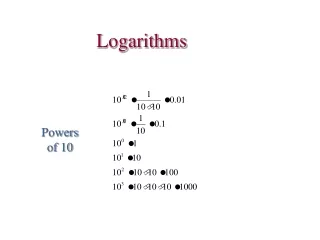
Exponential The special base 10 *10 a=10t
Logarithmic The special base10 *10 t=log10a t=log(a)
Exponential The special base e *e a=et
Logarithmic The special base e *e t=logea t=ln(a)
Logarithmic The special base e e≈2.7182818284 This number makes calculus easier *e t=logea t=ln(a)
Meanings • a=2t • I know t. • a is the result I get from raising 2 to the t power. • t=log2(a) • I know a. • t is the power I need to raise 2 to to get a.
Example • a=23 • a is the result I get from raising 2 to the power 3. • That result is 8. a=8. • t=log2(8) • t is the power I need to raise 2 to to get 8. • Since 23=8, t=3.
Exponential a=2t *2 No matter what power I use, the result is always positive
Exponential a=2t *2 There is no power that can get me a negative number
Logarithmic t=log2a *2 There is no power that can get me a negative number
Logarithmic t=log2a *2 I can only find the powers of positive numbers
Logarithmic t=log2a *2 I can only take the log of positive numbers
Logarithmic t=log2a *2 The domain of this function called “log2” is a>0
Logarithmic t=log2a *2 The domain of any log(whatever) is always whatever>0
Example problem • Find the domain of 2log7(4x-3)+7x-9 Whatever is inside the log has to be >0. I can find an answer whenever 4x-3>0 x>3/4
Find the domain: • x > 5/4 • x < 5/4 • x > -5/4 • x < -5/4 • None of the above
Find the domain: Whatever is inside the log has to be >0 5-4x>0 5>4x 5/4>x b) x < 5/4
Rewriting equations • y=bx x=logby • 2=3p p=log32 • q+3=79 9=log7(q+3) • 9=32x+1 2x+1=log39 • 7=e4 4=ln(7) or 4=loge(7) • x+2=102x-1 2x-1=log(x+2) or 2x-1=log10(x+2) • The result of the log is the exponent. • The result of the exponent is what goes inside the log.
Meanings • a=2t • I know t. • a is the result I get from raising 2 to the t power. • t=log2(a) • I know a. • t is the power I need to raise 2 to to get a. • What is 2log2(x)? • the result I get from raising 2 to the power I need to raise 2 to to get x = x.
Meanings • a=2t • I know t. • a is the result I get from raising 2 to the t power. • t=log2(a) • I know a. • t is the power I need to raise 2 to to get a. • What is log2(2x)? • The power that I need to raise 2 to so that I get the result of raising 2 to the x power. =x
Rewriting equations version 2 • 9=32x+1 • Taking the log of both sides. • Log3(9)=Log3(32x+1) • Log39=2x+1 • Exponentiating both sides • 3Log3(9)=32x+1 • 9=32x+1
Rewriting equations version 2 • 3x-7=e2x+1 • Taking the log of both sides. • ln(3x-1)=ln(e2x+1) • ln(3x-7)=2x+1 • Exponentiating both sides • eln(3x-7)=e2x+1 • 3x-7=e2x+1
Convert the following logarithmic expression into exponential form: y = ln(x+2). a) ey= x+2 b) 10y = x+2 c) e(x+2) = y d) 10 (x+2) = y e) None of the above
Convert the following logarithmic expression into exponential form: y = ln(x+2). y = ln(x+2) ey=eln(x+2) ey=x+2 A
Exponential Property adding multiplying 23+4=2324
Logarithmic Property adding multiplying Log(8*16)=log(8)+log(16)
The basic property of logarithims • Loga(bc)=logab+Logac
Example • Loga(b4) • =loga(bbbb) • =loga(b)+Loga(bbb) • =loga(b)+Loga(b) +Loga(b) +Loga(b) • =4Loga(b)
The basic properties of logarithims • Loga(bc)=logab+Logac • Loga(bn)=n*logab
Example • x=log832 what is x? • Rewrite as an exponential equation • 8x=32 • Take log2 of both sides • Log2(8x)=Log232 • xLog2(8)=Log232 • x=Log2(32)/Log2(8) • x=5/3
Change of base • x=logay what is x? • Rewrite as an exponential equation • ax=y • Take logc of both sides • Logc(ax)=Logcy • xLogc(a)=Logcy • x=Logc(y)/Logc(a) • logay=Logc(y)/Logc(a)
Change of base • Using this rule on your calculator • logay=Logc(y)/Logc(a) If you’re looking for the logayuse… Log(y)÷Log(a) Or ln(y)÷ln(a)
The basic properties of logarithims • Loga(bc)=logab+Logac • Loga(bn)=n*logab • Logab=logc(b)/logc(a) • Side effect: you only ever need one log button on your calculator. • Logab=log(b)/log(a) • Logab=ln(b)/ln(a)
Warning: Remember order of operations WRONG log(2ax) =x*log(2a) =x*[log(2)+log(a)] =x log 2 + x log a CORRECT log(2ax) =log(2(ax)) =log(2)+log(ax) =log(2)+x*log(a)
What about division? • Loga(b/c) • =Loga(b(1/c)) • =Loga(bc-1) • =Loga(b) + Loga(c-1) • =Loga(b) + -1*Loga(c) • =Loga(b) - Loga(c)
The advanced properties of logarithims • Loga(bc)=logab+Logac • Loga(bn)=n*logab • Logab=logc(b)/logc(a) • Side effect: you only ever need one log button on your calculator. • Logab=log(b)/log(a) • Logab=ln(b)/ln(a) • Loga(b/c)=logab-Logac
The advanced properties of logarithims • Loga(bc)=logab+Logac • Loga(bn)=n*logab • Logab=logc(b)/logc(a) • Side effect: you only ever need one log button on your calculator. • Logab=log(b)/log(a) • Logab=ln(b)/ln(a) • Loga(b/c)=logab-Logac • Loga(n√b̅)=[logab]/n