
SlideServe
Menu
Préférences
© SlideServe · v2026

### Enhancing Learning Through Reflective Action: Insights from Loertscher & Koechlin ###

warren avatar
7 diapositives · 238 Views · Aug 01, 2014

This text explores the fundamental principles of learning as presented by Loertscher and Koechlin. It emphasizes the importance of both content and the learning process, suggesting that students and educators must engage in reflective actions to deepen their understanding. Key questions about content, learning strategies, and future improvements encourage a continuous cycle of inquiry and self-assessment. By integrating reflection into learning practices, we can enhance our educational approaches and foster better learning outcomes in various contexts. ###
### 
Enhancing Learning Through Reflective Action: Insights from Loertscher & Koechlin

### - slide 1
01 / 7### Enhancing Learning Through Reflective Action: Insights from Loertscher & Koechlin ###
1 / 17

Télécharger la présentation

### Enhancing Learning Through Reflective Action: Insights from Loertscher & Koechlin ###
Une image / un lien ci-dessous est fourni (tel quel) pour télécharger la présentation

Politique de téléchargement : le contenu du site vous est fourni TEL QUEL pour votre information et votre usage personnel ; il ne peut être vendu, concédé sous licence ni partagé sur d’autres sites sans l’accord de son auteur.Le contenu vous est fourni TEL QUEL, pour votre information et votre usage personnel uniquement. Téléchargez la présentation en cliquant sur ce lien. Lors du téléchargement, si vous ne parvenez pas à télécharger une présentation, l’éditeur a peut-être supprimé le fichier de son serveur.Pendant le téléchargement, si vous ne parvenez pas à obtenir une présentation, le fichier a peut-être été supprimé par l’éditeur.

F I N

Plus de contenu associé

Transcription de la présentation
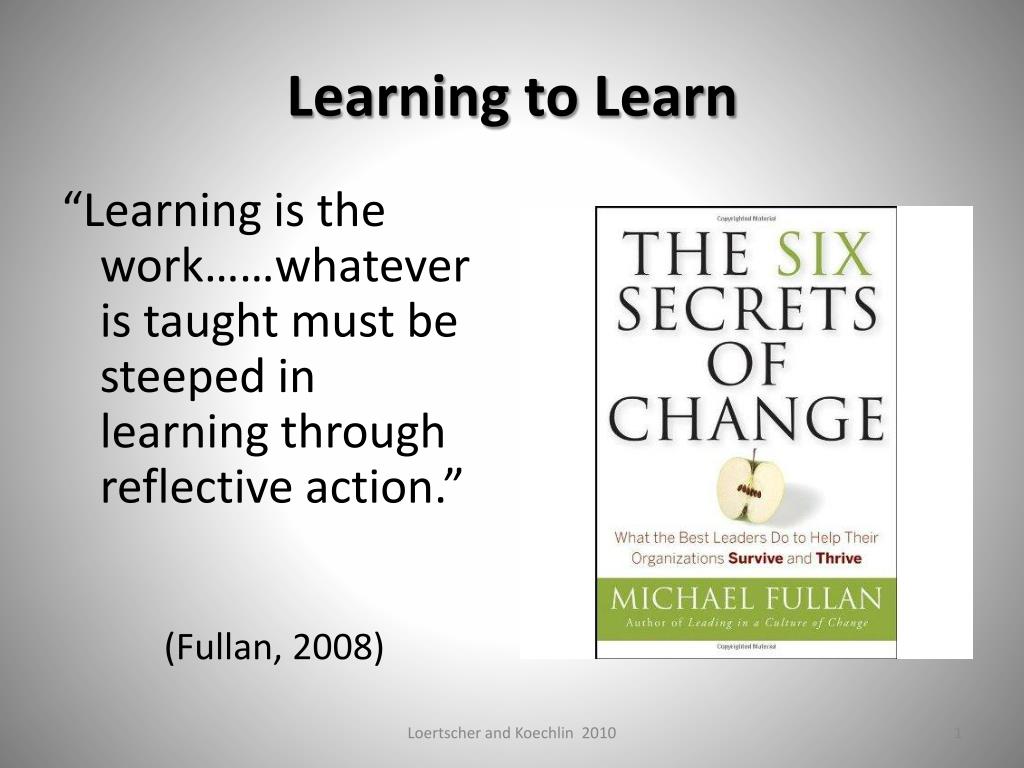
  1. Learning to Learn “Learning is the work……whatever is taught must be steeped in learning through reflective action.” (Fullan, 2008) Loertscher and Koechlin 2010

  2. Big Think about Content and Process:What We Know; How We Learn It Loertscher and Koechlin 2010

  3. BIG THINK about unit content • So What? • What are the important ideas we explored? • What does this tell us about the topic? • What does this mean? • What new understandings emerge? • What Next? • What new questions do I/we have? • What else do we want to explore? • How can we use what we know to do better next time? • What action can I/we take? • How can I/we make use of this new knowledge in the real world? Loertscher and Koechlin 2010

  4. BIG THINK about unit process What strategies did we use to learn? How did these strategies work for us? Which worked well or didn’t work well and for whom? • So What? Could we have learned more in the time we had? Are we all getting better as learners? • What Next? How can we use our findings to improve as learners? Loertscher and Koechlin 2010

  5. Triple Your Investment • Students • Consider content • Reflect on process • Teaching Partners • Reflect on learning • Improve teaching • School Improvement Loertscher and Koechlin 2010

  6. Teacher BIG THINK • Reflect on Learning • What did they learn? How did they learn it? • Why is this important? • Teaching to Learn • Content and Process • Ongoing Assessment and intervention • Teaching and Learning Strategies • Learning Environment Loertscher and Koechlin 2010

  7. Calgary Big Think Process Getting Better as Learners Content Making it Happen Loertscher and Koechlin 2010