Emergence of Self-Regulated Structures in Active Fluids
This study explores the self-regulation mechanism driving structure formation in active fluids, such as bacterial suspensions and artificial microswimmers. We demonstrate that the order-disorder transition is influenced by density, which is dynamically modified by the order parameter it induces. Our findings reveal solitary waves and breathing aster formations in active polar fluids, showcasing the interplay between self-regulation and activity. Ongoing investigations into emergent structures promise deeper insights into the dynamics of active nematics and polar fluids.

Emergence of Self-Regulated Structures in Active Fluids
E N D
Presentation Transcript
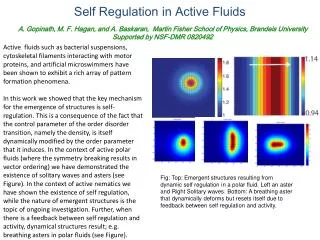
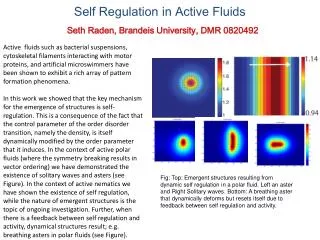
Self Regulation in Active Fluids Seth Raden, Brandeis University, DMR 0820492 Active fluids such as bacterial suspensions, cytoskeletal filaments interacting with motor proteins, and artificial microswimmers have been shown to exhibit a rich array of pattern formation phenomena. In this work we showed that the key mechanism for the emergence of structures is self-regulation. This is a consequence of the fact that the control parameter of the order disorder transition, namely the density, is itself dynamically modified by the order parameter that it induces. In the context of active polar fluids (where the symmetry breaking results in vector ordering) we have demonstrated the existence of solitary waves and asters (see Figure). In the context of active nematics we have shown the existence of self regulation, while the nature of emergent structures is the topic of ongoing investigation. Further, when there is a feedback between self regulation and activity, dynamical structures result; e.g. breathing asters in polar fluids (see Figure). Fig: Top: Emergent structures resulting from dynamic self regulation in a polar fluid. Left an aster and Right Solitary waves. Bottom: A breathing aster that dynamically deforms but resets itself due to feedback between self regulation and activity.