Understanding Molecular Formulas: Calculation and Examples
This article provides a comprehensive guide to understanding molecular formulas and how to calculate them from empirical formulas and molar masses. We will cover examples, including the determination of molecular formulas for compounds based on given empirical formulas and their respective molar masses, such as CH4N, CH3O, and C5H10O2. The process involves calculating the molar mass of the empirical formula, finding the molecular formula using the molar mass, and interpreting percent compositions to derive empirical formulas.

Understanding Molecular Formulas: Calculation and Examples
E N D
Presentation Transcript
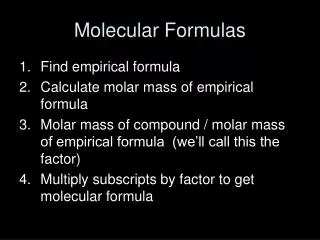
Molecular Formulas A molecular formula is either the same as an empirical formula or it is a simple whole number multiple of its empirical formula.
Determining Molecular Formulas Calculate the molecular formula of a compound whose molar mass is 60.0 g/mol and has an empirical formula of CH4N. What you need: Empirical Formula Molar Mass Calculate the molar mass of the empirical formula C: 12.0g x 1 H: 1.0g x 4 N: 14.0g x 1 = 12.0g = 4.0g = 14.0g 30.0 g/mol Molecular Formula Molar Mass 60.0 g/mol = 2 = Multiple 30.0 g/mol Empirical Formula Molar Mass CH4N x 2 Empirical Formula X Multiple = Molecular Formula = C2H8N2
Determining Molecular Formulas Find the molecular formula of ethylene glycol which has a molar mass of 62 g/mol and an empirical formula of CH3O. What you need: Empirical Formula Molar Mass Calculate the molar mass of the empirical formula C: 12.0g x 1 H: 1.0g x 3 O: 16.0g x 1 = 12.0g = 4.0g = 16.0g 31.0 g/mol Molecular Formula Molar Mass 62 g/mol = 2 = Multiple 31.0 g/mol Empirical Formula Molar Mass CH3O x 2 Empirical Formula X Multiple = Molecular Formula = C2H6O2
Determining Molecular Formulas The compound methyl butanoate has a percent composition of 58.8% C, 9.8% H, and 31.4% O and has a molar mass of 102 g/mol. What is its molecular formula? What you need: Empirical Formula Empirical Formula = C5H10O2 Molar Mass Calculate the molar mass of the empirical formula 58.8g C 1 mol C = 4.90 mol C C: 12.0g x 5 H: 1.0g x 10 O: 16.0g x 2 = 60.0g = 10.0g = 32.0g x 2 = 2.50 = 5 12.0g C 1.96 mol 9.8g H 1 mol H = 9.8 mol H 102.0 g/mol = 10 x 2 = 5.0 1.0g H 1.96 mol 102 g/mol = 1 31.4g O 102.0 g/mol 1 mol O = 1.96 mol O = 2 x 2 = 1.00 16.0g O 1.96 mol C5H10O2 x 1 = C5H10O2
Determining Molecular Formulas What is the molecular formula of a compound that has a percent composition of 94.1% O and 5.9% H and has a molar mass of 34 g/mol. What you need: Empirical Formula Empirical Formula = HO or OH Molar Mass Calculate the molar mass of the empirical formula 5.9g H 1 mol H H: 1.0g O: 16.0g = 5.9 mol H = 1.0 1.0g H 5.88 mol 17.0 g/mol 94.1g O 1 mol C = 5.88 mol O = 1.00 16.0g O 34 g/mol 5.88 mol = 2 17.0 g/mol HO x 2 = H2O2 or O2H2