Download
1 / 32
380 likes | 584 Vues
This overview summarizes key aspects of Solar Energetic Particle (SEP) events, focusing on their significance in space weather. It discusses characteristics such as intensity, spectra, and composition, along with current predictive capabilities and ongoing research questions. The presentation highlights tools available for studying SEPs, their potential dangers to astronauts, instruments, and power grids, and the importance of understanding these phenomena for improving prediction accuracy. Insights are drawn from various spacecraft and monitoring systems.

E N D
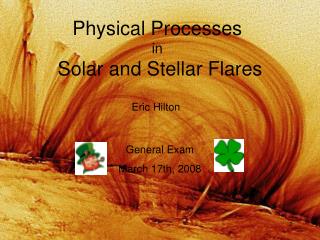
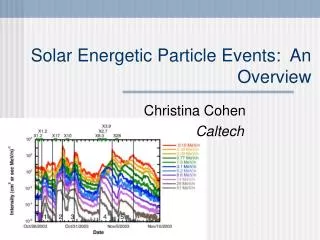
Solar Energetic Particle Events: An Overview Christina Cohen Caltech
Overview of the Overview • Space Weather and SEP events • Why? • Tools we can use • Characteristics of interest • Intensity (peak, rise time, duration) • Spectra • Composition • Current predictive capability • Current questions for study
Space Weather Intensity Spectra Composition Predictions Questions Space Weather & SEP Events • Why? • Danger to astronauts, instruments, power grids, etc • Understanding enables predictions • Tools at our disposal • SEPs (ions, electrons) • Spacecraft (ACE, Wind, SoHO, GOES) • Neutron monitors • Solar • CMEs (LASCO) • X-ray (SXI, GOES, RHESSI) • Other (MDI, EIT, TRACE...) • Radio (WAVES, ground-based)
Space Weather Intensity Spectra Composition Predictions Questions Space Weather & SEP Events MDI EIT LASCO LASCO GOES/XRAY ACE ULEIS-SIS
Space Weather Intensity Spectra Composition Predictions Questions EPAM
Space Weather Intensity Spectra Composition Predictions Questions EPAM LASCO CME time-height profile <4 Rs
Space Weather Intensity Spectra Composition Predictions Questions Wind/WAVES
Space Weather Intensity Spectra Composition Predictions Questions Characteristics - IntensityVariability • Varies with everything • event • time
Space Weather Intensity Spectra Composition Predictions Questions Characteristics - IntensityVariability Oxygen • Varies with everything • event • time • species Protons
Space Weather Intensity Spectra Composition Predictions Questions Characteristics - IntensityPeak Limitations • streaming limit Reames & Ng 1998 • proton-generated turbulence limits intensities
Space Weather Intensity Spectra Composition Predictions Questions Characteristics - IntensityPeak Limitations • streaming limit Reames & Ng 1998 • proton-generated turbulence limits intensities • All bets offat ESP events
Space Weather Intensity Spectra Composition Predictions Questions Characteristics - IntensityPeak Limitations • Exceptions - Jan 20, 2005
Space Weather Intensity Spectra Composition Predictions Questions Characteristics - IntensityRise Time • rise time - generally depends on longitude relative to flare • Fast=western • Slow=eastern Cane et al. 1988
Space Weather Intensity Spectra Composition Predictions Questions Characteristics - IntensityRise Time • rise time - generally depends on longitude relative to flare • Fast=western • Slow=eastern • Jan 20, 2005 • faster than most • W61 >100 MeV
Space Weather Intensity Spectra Composition Predictions Questions Characteristics - IntensityRise Time • rise time - generally depends on longitude relative to flare • Fast=western • Slow=eastern • Jan 20, 2005 • faster than most • W61 • >100 MeV fluencein first few hours was greater than any other event since1976
Space Weather Intensity Spectra Composition Predictions Questions Characteristics - IntensityTheoretical Understanding • CME-driven shocks • strong shocks - Fermi acceleration Lee 2005
Space Weather Intensity Spectra Composition Predictions Questions Characteristics - IntensityTheoretical Understanding Zank et al. 2001 • CME-driven shocks • strong shocks • central meridian (nose of shock) gives largest increase 4 of the top 6 events of 1997-2004
Space Weather Intensity Spectra Composition Predictions Questions Characteristics - SpectraVariability • most large events show roll-off Oxygen
Space Weather Intensity Spectra Composition Predictions Questions Characteristics - SpectraVariability • most large events show roll-off • power law events - problem at high energy
Space Weather Intensity Spectra Composition Predictions Questions Characteristics - SpectraVariability • most large events show roll-off • power law events - problem at high energy
Space Weather Intensity Spectra Composition Predictions Questions Characteristics - SpectraTheoretical Understanding • Power law determined by shock strength • Roll-off determined by escape,species dependent Li et al. 2005 CNO Lee 2005 H Fe Kinetic energy (MeV/n)
Space Weather Intensity Spectra Composition Predictions Questions Characteristics - CompositionVariability • mostly protons H He C x 10 O Fe
Space Weather Intensity Spectra Composition Predictions Questions Characteristics - CompositionVariability • mostly protons • heavy ions still important • not predictable from proton measurements H O Fe
Space Weather Intensity Spectra Composition Predictions Questions Characteristics - CompositionVariability • mostly protons • heavy ions still important • not predictable from proton measurements • very variable
Space Weather Intensity Spectra Composition Predictions Questions Characteristics - CompositionVariability • mostly protons • heavy ions still important • not predictable from proton measurements • very variable • dependent on energy
Space Weather Intensity Spectra Composition Predictions Questions Characteristics - CompositionTheoretical Understanding • Shock acceleration • Variations dependon Q/M
Space Weather Intensity Spectra Composition Predictions Questions Characteristics - CompositionTheoretical Understanding • Shock acceleration • Variations dependon Q/M • seed population (not SW)
Space Weather Intensity Spectra Composition Predictions Questions Characteristics - CompositionTheoretical Understanding • Shock acceleration • Variations dependon Q/M • seed population (not SW) • flare suprathermals for high Fe events?? Still don’t know how to generate element-dependent power law slopes Tylka et al. 2005
Space Weather Intensity Spectra Composition Predictions Questions Current Predictive Capability • Tools • neutron monitors • L1 monitors (ACE RTSW) • ESP events • peak events • Solar - CMEs, Flares, Active Regions • Theoretical Understanding (models) • But currently can’t predict SEP characteristics from solar observations
Space Weather Intensity Spectra Composition Predictions Questions Current Predictive Capability • Current Techniques • shock arrival • Average uncertainty in arrival time • 24 hrs in advance => 8.9 hrs • 12 hrs in advance => 4.6 hrs Vandegriff et al. 2005
Space Weather Intensity Spectra Composition Predictions Questions Current Predictive Capability • Current Techniques • shock arrival • ESP L1 detection • 30-60 minutes warning
Space Weather Intensity Spectra Composition Predictions Questions Current Questions for Study • Acceleration • Details of the process • Requirements • Pre-conditioning • Turbulence from previous events • Suprathermal population (flares) • Solar signatures • What feature? CME brightness/speed? Flare size/duration? • future missions - STEREO, Sentinels