Sense Sensitive Design And The Learning Environment
Sense Sensitive Design And The Learning Environment. Richard Mazuch | Learning Spaces Conference, Cardiff 11.03.2013. how things are perceived. Sight Light Colour Vista Hearing Sounds Noise Touch Texture Temperature. Smell Odours Aromas Taste Sweet Sour Bitter

Sense Sensitive Design And The Learning Environment
E N D
Presentation Transcript
Sense Sensitive Design And The Learning Environment Richard Mazuch | Learning Spaces Conference, Cardiff 11.03.2013
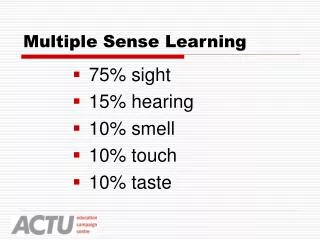
how things are perceived Sight • Light • Colour • Vista Hearing • Sounds • Noise Touch • Texture • Temperature Smell • Odours • Aromas • Taste • Sweet • Sour • Bitter • Salty “children learn best when all senses are engaged” Dyck – 2002, Kennedy – 2005 Waldecker – 2005, Faily – 1979 Fielding – 2006, Daggett - 2008
Blood Oxygen Content Kinaesthesis Sight Mechanoreception Umami Light Blood Pressure Cerebrospinal fluid pH Proprioception – Joint Position Plasma osmotic pressure Artery-vein blood glucose difference Hearing Smell Colour Lung inflation Balance Temperature Heat Sweet Taste Touch Cold Sour Salt Bitter Pain
body system • Physiological/ Autonomic System • Breathing, Circulation, Digestion… • Motor System • Muscle tone, Posture, Movement Patterns… • State System • Sleep, Awake, Weak, Restless, Anxious…
vision: IMPAIRED • Impaired vision – Impaired learning • Myopic • Astigmatism • Diabetic retinopathy • Tunnel vision • Blind • Muscular degeneration • May occur together 40% of Children with learning disabilities have an eyesight impairment “Up to 2 million children may be falling behind at school because of sight problems” – RNIB 2003
Not mad, just slightly depressed. vision: LIGHT Facts • Full spectrum lighting promotes learning and growth • In absence of sunlight, melatonin tells the body to ‘switch off’ • Daylight resets circadian clocks • Metabolises vitamin D • Sunlight releases serotonin Heschong Mahone 1999
vision: LIGHT Holistic lighting environment • Good lighting environment – visual + biological • Natural light provided from at least 2 sides • Connection with the outside • Daily change of light • Ability to control and calibrate • Easy & accessible to controls HEAD study 2012
vision: LIGHT Lighting affects • Perception of visual stimuli • Mental attitude • Performance • Health McColl/ Veitch Fisher – 2001, Hathaway – 1995 Young – 2003, Erwine 2002, Barrett 2009
vision: LIGHT Innovations • Sunpipes • Colour sensitive lighting • Sound responsive lighting • Electronically responsive glazing • Poor Light • Headaches • Eyestrain • Fatigue • Poor Focus M. Winterbottom 2007 Karpen 93 Barritt 03 Brown 1921
vision: LIGHT Innovations • White light • Darkness • Red light • Pink light • Blue light Who do you think is more sensitive? A Child or a pumpkin? University of Freiburg research
vision: LIGHT How do we improve learning • Optimise daylight • Correct lighting • Stimulates without distraction • Assists concentration • Increases attention span • Improves sense of time • Reduces eye fatigue
vision: COLOUR Provokes hormone release that affects • Mood • Mental clarity • Energy levels • Body systems Naz Kaya, H Epps -2004 Linton H – 1999 Saito -1996 Creating a Colour-sensitive Built Environment P Barnett / Y Zhang – 2011 HEAD project. Salford Univ & IBI Nighitngale - 2012
vision: COLOUR How do we manage behaviour • Reflect a child’s emotional development to adulthood • Reduce blood pressure and aggressive behaviour • Improve morale • Assist wayfinding Boyatzis/ Varghese – 1994 Davey P 1998
vision: COLOUR How do we support learning • Neutral colours = under-stimulating, • distracting environments • Most effective learning environments • Infants(y1-3)=cool colours • Older children(y4-6) = warmer colours Children ‘Likes’ preferences Mahnke (1996) Children ‘Perform better’ HEAD (2012)
vision: COLOUR How can we deliver colour Davey P – 1998, Saito – 1996 HEAD 2012
vision: COLOUR How can we deliver colour Naz Kaya – 2004, Boyatizis – 1994 Linton - 1999
vision: VISTA Innovations • Views into learning areas to stimulate • Calming views from study areas • Contrast and de-stress • Social areas to encourage interaction • Display areas • Activity areas Joe Fischer, Heschong - 2003
sound Speech intelligibility is affected by TBC • Reverberation time • Room Shape • Relationship of speech to background noise • Listener’s hearing • Halls • Corridors • Playgrounds • Gymnasium • Toilets • Study areas Problem areas TBC
sound Noise affects • Attention • Memory • Problem solving • Decision-making • The limbic system • Improves function of autonomic nervous system • Lowers blood pressure and heart rate
touch Facts • Skin is the largest sensory organ (about 1.75 square metres) • We touch with our noses, lips, toes, elbows, back, bottom • Skin may be sensitive, burnt, cut, bruised, blistered Young – 2003, Barrett– 2009 Earlhman 2002 & Fisher 2001
touch Air pollution • Growing % of children suffer allergies, asthma, eczemas respiratory problems, headaches • Plants absorb toxins Airborne toxins, formaldehyde, benzene, carbon monoxide trichloroethylene etc. • Interior plantscape – less fatigue, headaches and concentration problems • Strict ‘off-gassing’ Scandinavian legislation (NASA research 1989), (Dr Trove Fjeld, 1995) A Whietal – 2011, Barrett – 2009 Young - 2003, Erhorn – Kluttig - 2005
touch Temperature/ Ventilation FACTS • 25°C+ = -Affect on Maths & Reading • > Temps < Natural Air = + performance • < Natural Air = < 5.4% Performance • < Pollen = 63% lower grades than their average • < CO2 = >Attention Span < Lethargy • Temp = < Dehydration/ Lethargy • O2 Oxygen Bars • Building Bulletin 101 • Ventilation in Schools Douglas/ Gifford 2001, Wygorcki/ Wym/ Matysiak Walker, Khon, Fletcher, Coley/ Greeves 2004
smell FACTS • Personal Hygiene • OD – Antiperspirant • OD – Deodorant • OD – Perfume • Multicultural Diets • Hormone Surges • Toilets • Cleaning fluids • Farting
smell FACTS • Odours • Unpleasant smells increase heart rate • and respiration and also impair • learning • Floral and fruit fragrances • Aid concentration • Slow respiration • Lower blood pressure/heart rate • Relax muscles
Kajima headquarters smell INNOVATION • Partnership with Shiseido • Aroma through air conditioning system at different times of day Citrus: wake up call Floral: concentration Woodland: relaxation • Diminishes stress • Sense of well-being Shiseido/Kajima Research – Tokio 1998
Jamie Oliver – 2005 “Campaign for better School Meals” taste Food and drink • Feel good • Nutrition • Energy • Pleasure • Poor Diet • E number foods • High sugars • Allergies • Poisons “Pupil Food pill plan” Sept 2008 Wesnes – 2003 21 Studies – Verify improvement in performance post breakfast.
space FACTS • Seven ages of children • Scale • Proportions • Proxemics • Defensible space • Rhythm • Ergonomics • Anthropometrics • Flexibility S. Pivak, P. Wasley/ M. Fine et al – 2000 D.Douglas/ R., Gifford – 2001 Greenman,,J – 2004 & 2007, Olds, A - 1997
space How do we support learning • Allow adaptation of spatial arrangement • Provide Choice of learning zones • Flexibility empowers both teacher and learner and a positive impact on the effectiveness of the learning environment. HEAD study 2012
7 Ages V.F. Reyna/ F.Farley -2008
Physiological Issues Oxytocin melatonin oestrogen progesterone cortisol melatonin testosterone cortisol seratonin Nor-adrenaline dopamine testosterone
Developmental Issues problems with peers Treatment adherence problems problems with attachment and loss Emotional difficulties Anxiety Forensic Eating Disorders problems sleeping anger low self-esteem violence Substance misuse Behavioural difficulties problems in the family problems communicating problems with school Developmental / disability difficulties self-harm Relationship difficulties over activity depression mood swings sexualisedbehaviours destructiveness obsessive behaviours
Developmental issues • Physiological • Physical • Emotional • Sexual • Social • Behavioural
Brain Profiling Verbal: Involved in language skills, Controls speech, reading, writing and spelling. It remembers facts, recalls names, dates and figures. Logical and Analytical: Deals with information in a concrete way, understands only literal meaning. Linear: Information is processed sequentially, a step-by-step way of thinking. Organised: Information is preferred in a Structured and systematic way. Non-Verbal: Prefers to work with images rather than words. Metaphorical: Understands images and metaphors. Sees the picture in the literal meaning, fantasies, makes up stories. Non-linear (holistic): Sees the big picture, makes intuitive leaps and ignores sequential processing. Can create and use many types of information simultaneously. Recalls the face as a whole. Spatial: Understands depth and multi-dimensional perception. Allows individual to find way without following a map. Feeling: Processes feeling, intuition, sensitivity and people- awareness
Brain Profiling Spivak - 1996
sense of time FACTS • Short winter days • Attention spans • Energy levels • Periods of deep concentration • Resetting circadian clocks
sense of time FACTS • “Adolescents have a bio-predisposition to sleep longer • in the morning” • Memory capacity test results: • Morning – 42% correct answers • Afternoon – 51% correct answers • (matches findings in Canada & USA) • Dr. Paul Kelly – Monkseaton High School • “Radical timetable change needed to match body clocks” • New Curriculum: • - Core Learning – 11:00am – 3:00 pm • - Independent learning either side Russell Foster + Dr. Paul Kelley - 2008
Emotional Mapping • Emotional Mapping is a new & exciting innovative design tool • Enables teachers and designers to navigate through the emotions, feelings, sentiments and sensations of pupils and students
Emotional Mapping Flashpoint Areas • Corridors • Toilets • Halls • Dining areas/ Refectories • Outside spaces • Library • Social spaces • Resource Centres Pleasant Spaces Coventry Children’s Hospital
a space to engage all the senses a truly magical healing, place A space to address; • Learning phobia • Speech disorders • Speech impairment • Dyslexia • Dyspraxia • Dyscalculia • Autism • Hyperactivity • Challenging behaviour • Withdrawn / isolation
Design Decision • Physiological Condition • Psychological Condition • Emotional Condition • Physical Condition
If you would like to discuss any of these issues further please contact Richard Mazuch Richard.Mazuch@IBIGroup.com Twitter: @IBI_THiNK Website: www.ibi-nightingale.com