Synthetic Aspects of Chemical Vapor Transport: Dynamics and Mechanisms
270 likes | 403 Vues
This document explores the principles and kinetics of chemical vapor transport, focusing on the movement of nonvolatile reactants/products along a temperature gradient. It details the experimental setup involving crude ZnS and iodine at various temperatures, elucidating the roles of gaseous species and reaction dynamics. Key factors influencing transport rates, including pressure gradients and diffusion coefficients, are analyzed, providing insights into gas motion in closed systems. The findings underscore the complexities of heterogeneous reactions and chemical transport reactions.


Synthetic Aspects of Chemical Vapor Transport: Dynamics and Mechanisms
E N D
Presentation Transcript
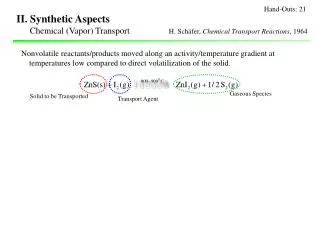
Hand-Outs: 21 II. Synthetic Aspects Chemical (Vapor) Transport H. Schäfer, Chemical Transport Reactions, 1964 Nonvolatile reactants/products moved along an activity/temperature gradient at temperatures low compared to direct volatilization of the solid. Gaseous Species Solid to be Transported Transport Agent
Hand-Outs: 21 II. Synthetic Aspects Chemical (Vapor) Transport H. Schäfer, Chemical Transport Reactions, 1964 Nonvolatile reactants/products moved along an activity/temperature gradient at temperatures low compared to direct volatilization of the solid. Gaseous Species Solid to be Transported Transport Agent Standard Set-Up: crude ZnS(s) and I2(s) placed into closed container; enough I2(s) to give 0.1-1.0 atm at ca. 900C; ends of container are heated to 800C and 900C, creating a temperature (and pressure) gradient in the tube. I2: transport agent (very common; also HCl(g) and O2(g)) H > 0 (endothermic): ZnS(s) transported from high T to low T. ZnS(s, crude) + I2 ZnS(s, pure) I2(g) + ZnI2(g) + S2(g) 900C 800C
Hand-Outs: 21 II. Synthetic Aspects Chemical (Vapor) Transport H. Schäfer, Chemical Transport Reactions, 1964 ZnS(s, crude) + I2 ZnS(s, pure) I2(g) + ZnI2(g) + S2(g) 900C 800C • “Local” equilibrium pertains: heterogeneous reaction faster than diffusion of ZnI2 + S2; • Diffusion of I2 is also not significant with respect to “background” gas = I2(g); • Rate-determining transport of ZnI2 and S2 depends on • (i) difference in equilibrium pressures at 800C and 900C; • (ii) diffusion coefficients of gases; • (iii) cross-sectional area and length of the reaction tube. Transport Rate: (mg/hr or mg/day)
Hand-Outs: 21 II. Synthetic Aspects Chemical (Vapor) Transport H. Schäfer, Chemical Transport Reactions, 1964 Principles: (1) Heterogeneous reaction of the gas B on the solid A; (2) Gas (B + C) motion in the container; (3) Heterogeneous reaction to reform solid A. Usually rate-determining step
Hand-Outs: 21 II. Synthetic Aspects Chemical (Vapor) Transport H. Schäfer, Chemical Transport Reactions, 1964 Principles: (1) Heterogeneous reaction of the gas B on the solid A; (2) Gas (B + C) motion in the container; (3) Heterogeneous reaction to reform solid A. Usually rate-determining step Nature of the Gas Motion depends on Total Gas Pressure in the Container (Closed): (a) Low total pressure (< 103 atm) Mean free path of gas molecules container dimensions – Molecular Flow (tendency to equalize pressure throughout the container) (b) High total pressure (> 103 atm) Uniform gas density (constant total pressure throughout system) but a nonuniform composition (gradient) – Diffusion (tendency to equalize concentration throughout the container) (NOTE: rate of diffusion decreases as total pressure increases) (c) Very high total pressure – Convection (tendency to equalize temperature throughout the container)
Hand-Outs: 22 II. Synthetic Aspects Chemical (Vapor) Transport H. Schäfer, Chemical Transport Reactions, 1964 Kinetics: What is the rate of chemical transport? (# moles A(s) transported, nA, in time t) A(s, crude) + B A(s, pure) B(g) + C(g) T1 T2 From Stoichiometry: From Diffusion Theory:
Hand-Outs: 22 II. Synthetic Aspects Chemical (Vapor) Transport H. Schäfer, Chemical Transport Reactions, 1964 Kinetics: What is the rate of chemical transport? (# moles A(s) transported, nA, in time t) A(s, crude) + B A(s, pure) B(g) + C(g) T1 T2 From Stoichiometry: From Diffusion Theory: Gas “DIFFUSION” Gas “FLOW” H. Schäfer et al., Z. anorg. Allg. Chem. 286, 27-55 (1956) cB, cC = concentrations of gases (moles/cm3) A = cross sect. area (cm2) D = diffusion coeff. for B(g) + C(g) (cm2/sec) s = length (cm) t = time of experiment (sec)
Hand-Outs: 22 II. Synthetic Aspects Chemical (Vapor) Transport H. Schäfer, Chemical Transport Reactions, 1964 Kinetics: What is the rate of chemical transport? (# moles A(s) transported, nA, in time t) A(s, crude) + B A(s, pure) B(g) + C(g) T1 T2 AND
Hand-Outs: 22 II. Synthetic Aspects Chemical (Vapor) Transport H. Schäfer, Chemical Transport Reactions, 1964 Kinetics: What is the rate of chemical transport? (# moles A(s) transported, nA, in time t) A(s, crude) + B A(s, pure) B(g) + C(g) T1 T2 AND Estimates: (P.W. Atkins, Physical Chemistry)
Hand-Outs: 22 II. Synthetic Aspects Chemical (Vapor) Transport H. Schäfer, Chemical Transport Reactions, 1964 Kinetics: What is the rate of chemical transport? (# moles A(s) transported, nA, in time t) A(s, crude) + B A(s, pure) B(g) + C(g) T1 T2
Hand-Outs: 22 II. Synthetic Aspects Chemical (Vapor) Transport H. Schäfer, Chemical Transport Reactions, 1964 Kinetics: What is the rate of chemical transport? (# moles A(s) transported, nA, in time t) A(s, crude) + B A(s, pure) B(g) + C(g) T1 T2 Chemical Controls Maximize pB: Reaction Thermodynamics Physical Controls Wide, short tubes; Higher temperatures
Hand-Outs: 23 II. Synthetic Aspects Chemical (Vapor) Transport H. Schäfer, Chemical Transport Reactions, 1964 Thermodynamics: What is the direction of chemical transport? A(s, crude) + B A(s, pure) B(g) + C(g) T1 T2 High T to Low T (Hot-to-Cold)? -OR- A(s, pure) A(s, crude) + B B(g) + C(g) T2 T1 Low T to High T (Cold-to-Hot)?
Hand-Outs: 23 II. Synthetic Aspects Chemical (Vapor) Transport H. Schäfer, Chemical Transport Reactions, 1964 Thermodynamics: What is the direction of chemical transport? Conditions: pTOT = pB + pC = 1 atm; T1 = 1073 K, T2 = 1273 K CalculatepB(T2) and pB(T1) and then pB = pB(T2) pB(T1)
: constant S0, vary H0 Hand-Outs: 23 II. Synthetic Aspects Chemical (Vapor) Transport H. Schäfer, Chemical Transport Reactions, 1964 pTOT = pB + pC = 1 atm; T1 = 1073 K, T2 = 1273 K pB = pB(T2) pB(T1) = pB(H0): plot… Exothermic Endothermic pB(T2) > pB(T1) pB(T2) < pB(T1)
: constant S0, vary H0 Hand-Outs: 23 II. Synthetic Aspects Chemical (Vapor) Transport H. Schäfer, Chemical Transport Reactions, 1964 pTOT = pB + pC = 1 atm; T1 = 1073 K, T2 = 1273 K pB = pB(T2) pB(T1) = pB(H0): plot… Exothermic Endothermic pB sizable; xB(T2) < xB(T1) A(s) forms at T1 Hot-to-Cold pB sizable; xB(T2) > xB(T1) A(s) forms at T2 Cold-to-Hot pB(T2) > pB(T1) pB(T2) < pB(T1)
: constant S0, vary H0 Hand-Outs: 23 II. Synthetic Aspects Chemical (Vapor) Transport H. Schäfer, Chemical Transport Reactions, 1964 pTOT = pB + pC = 1 atm; T1 = 1073 K, T2 = 1273 K pB = pB(T2) pB(T1) = pB(H0): plot… Exothermic Endothermic pB sizable; xB(T2) < xB(T1) A(s) forms at T1 Hot-to-Cold With S0 > 0, only endothermic equilibrium creates transport conditions. pB(T2) < pB(T1)
: constant S0, vary H0 Hand-Outs: 23 II. Synthetic Aspects Chemical (Vapor) Transport H. Schäfer, Chemical Transport Reactions, 1964 pTOT = pB + pC = 1 atm; T1 = 1073 K, T2 = 1273 K pB = pB(T2) pB(T1) = pB(H0): plot… Exothermic Endothermic With S0 < 0, only exothermic equilibrium creates transport conditions. pB sizable; xB(T2) > xB(T1) A(s) forms at T2 Cold-to-Hot pB(T2) > pB(T1)
Hand-Outs: 24 II. Synthetic Aspects Chemical Transport “Rules” H. Schäfer, Chemical Transport Reactions, 1964 • A reaction supports transport only when no solid is present on one side of the chemical • equation; • A reaction with an extreme equilibrium position (large |H0|) gives no measurable transport; • Sign of H0 determines the transport direction: • Exothermic reactions transport from low T to high T; • Endothermic reactions transport from high T to low T; • When H0 = 0, p = 0 and no transport takes place; • For any value of S0 0, there is a value of H0 that gives maximum transport; • For large |S0|, transport is only possible when H0 and S0 have the same sign: • Transport becomes significant when ln Kp is ca. 0; • If S0 is small, then, depending on the sign of H0, transport can take place in either • direction; • Reactions with large, positive S0, transport can only occur from high T to low T (H0 > 0); • Maximum transport value increases with an increasing magnitude of S0, when H0 changes • correspondingly and p becomes larger. Justifies I2 as useful transport agent: M-I bonds are weaker than other M-X bonds, so H0 typically small.
Hand-Outs: 25 II. Synthetic Aspects Chemical (Vapor) Transport H. Schäfer, Chemical Transport Reactions, 1964 7 Nb(s) + 8 NbCl5(s) 5 Nb3Cl8(s) Transport Equilibrium: H0 = + 457.3 kJ/mol Nb3Cl8; S0 = + 487.9 J/Kmol Nb3Cl8; Therefore, G0~ 0 at 937 K = 664 C Therefore, (a) Optimum controlled transport conditions will happen around 900 K; (b) Use Kp(T) and pTOT~ 1 atm to determine partial pressures of gases; (c) Endothermic equilibrium: transport to low T, place reactants in hot end.
Hand-Outs: 25 II. Synthetic Aspects Chemical (Vapor) Transport H. Schäfer, Chemical Transport Reactions, 1964 Transport Equilibrium:
Hand-Outs: 25 II. Synthetic Aspects Chemical (Vapor) Transport H. Schäfer, Chemical Transport Reactions, 1964 Transport Equilibrium: 5 Nb3Cl8(s) 7 Nb(s) + 8 NbCl5(g) NbCl4(g) NbCl5(g) Product grows here Transport Temperatures pi= 0.2-0.3 atm
Hand-Outs: 25 II. Synthetic Aspects Chemical (Vapor) Transport H. Schäfer, Chemical Transport Reactions, 1964 Transport Equilibrium: Estimate Transport Rate: Tube: 20 cm long, 1 cm diameter T1 = 700 K, T2 = 800 K p(NbCl5) = 0.25 atm. (Need ca. 0.065 g NbCl5 for ca. 1 atm pressure) NOTE: (1) Generally favorable to keep temperature gradient small; (2) At high temperatures, 5 Nb3Cl8(s) 7 Nb(s) + 8 NbCl5(g); (3) Another competing phase is “Nb3Cl7(s)” = Nb6Cl14(s), so even cooler transport temperatures chosen in the experiment (ca. 650-700 K); increases time by factor of 7-10.
Hand-Outs: 26 II. Synthetic Aspects Examples of Chemical Transport H. Schäfer, Chemical Transport Reactions, 1964 Low conversion due to protective skin that grows on the metal surface and prevents further reaction; 2 mg I2 / cm3 gives nearly complete conversion. H0 = 300 kJ/mol: transport from low T to high T; efficient to purify noble metals. W filaments in an atmosphere with a small partial pressure of WCl6(g0 can sustain themselves by transport. H0 < 0, so W is cold (thicker) parts of filament transport to hot (thinner) parts of the filament.
Hand-Outs: 26 II. Synthetic Aspects Examples of Chemical Transport H. Schäfer, Chemical Transport Reactions, 1964 A small amount of I2 transports red P by forming P2I4(g), which then froms metal phosphides and regenerates the transport agent. Disproportionation Reactions: often endothermic processes and typically S0 > 0, so they are good candidates for transport equilibria:
Hand-Outs: 26 II. Synthetic Aspects Examples of Chemical Transport H. Schäfer, Chemical Transport Reactions, 1964 Separation / Purification Reactions: mixture of M(s) and M(s) (1) M(s) transports; M(s) volatilizes (2) M(s) transports; M(s) does not: Nb(s) and NbC(s) (3) M(s) and M(s) transport in same direction – 2 different temperature ranges; impure (4) M(s) transports by exothermic equilibrium; M(s) by endothermic equilibrium: Cu(s) and Cu2O(s) mixture using HCl(g) as transport agent… Exothermic: cold-to-hot, so load mixture in cold end of the tube.
Hand-Outs: 26 II. Synthetic Aspects Examples of Chemical Transport H. Schäfer, Chemical Transport Reactions, 1964 Separation / Purification Reactions: mixture of M(s) and M(s) (1) M(s) transports; M(s) volatilizes (2) M(s) transports; M(s) does not: Nb(s) and NbC(s) (3) M(s) and M(s) transport in same direction – 2 different temperature ranges; impure (4) M(s) transports by exothermic equilibrium; M(s) by endothermic equilibrium: Cu(s) and Cu2O(s) mixture using HCl(g) as transport agent… Exothermic: cold-to-hot, so load mixture in cold end of the tube. NOTE: 600 C Cu2O 1100 C
Hand-Outs: 26 II. Synthetic Aspects References Reginald Gruehn and Robert Glaum, “New results of chemical transport as a method for the preparation and thermochemical investigation of solids,” Angewandte Chemie, International Edition (2000), 39(4), 692-716. M. Lenz and Reginald Gruehn, “Developments in Measuring and Calculating Chemical Vapor Transport Phenomena demonstrated on Cr, Mo, W, and Their Compounds,” Chemical Reviews (Washington, D. C.) (1997), 97(8), 2967-2994. Mercouri Kanatzidis, Rainer Pottgen, Wolfgang Jeitschko, “The metal flux: A preparative tool for the exploration of intermetallic compounds,” Angewandte Chemie, International Edition (2005), 44(43), 6996-7023.