Understanding Redox Reactions: Balancing in Acid and Base Conditions
This guide provides a comprehensive overview of balancing redox reactions in both acidic and basic conditions. It covers essential concepts such as oxidation states, oxidation and reduction processes, and the steps involved in balancing half-reactions. Practical examples include the reactions of zinc with hydrochloric acid, the oxidation of arsenic, and the balancing of reactions involving manganate ions. Clarity in balancing electrons lost and gained is emphasized, ensuring a solid foundation in understanding redox processes. Perfect for chemistry students and enthusiasts alike!

Understanding Redox Reactions: Balancing in Acid and Base Conditions
E N D
Presentation Transcript
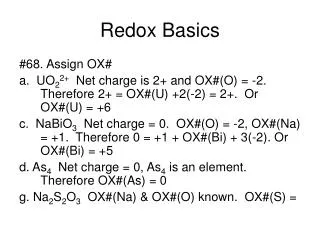
Redox Basics #68. Assign OX# a. UO22+ Net charge is 2+ and OX#(O) = -2. Therefore 2+ = OX#(U) +2(-2) = 2+. Or OX#(U) = +6 c. NaBiO3 Net charge = 0. OX#(O) = -2, OX#(Na) = +1. Therefore 0 = +1 + OX#(Bi) + 3(-2). Or OX#(Bi) = +5 d. As4 Net charge = 0, As4 is an element. Therefore OX#(As) = 0 g. Na2S2O3 OX#(Na) & OX#(O) known. OX#(S) =
Redox Basics #72.Redox?, oxidized?, reduced? OA?, RA? CH4(g) + H2O(g) CO(g) + 3H2(g) • -4, +1 +1, -2 +2, -2 0 • OX# of carbon increases from -4 to +2; C loses e-s and is oxidized; methane = RA • OX# of hydrogen decreases from +1 to 0; H gains e-s and is reduced; water = OA
Redox Basics #72.Redox?, oxidized?, reduced? OA?, RA? c. Zn(s) +2HCl(aq) ZnCl2(aq) + H2(g) • 0 +1, -1 +2, -1 0 • Zn is oxidized; Zn loses e-s; Zn = RA • H is reduced; H gains e-s; HCl = OA • 2H+(aq)+2CrO42-(aq)Cr2O72(aq)+H2O(l) • +1 +6, -2 +6, -2 +1, -2
Balance Redox Rxn in Acid #74a. Cu(s) +NO3-(aq) Cu2+(aq)+ NO(g) 0 +5, -2 +2 +2, -2 • Cu is oxidized; N is reduced • Cu(s) Cu2+(aq) oxidation ½ rxn • No O or H to balance in oxid ½ rxn • NO3-(aq) NO(g) reduction ½ rxn • NO3-(aq) NO(g) +2H2O(l) Balance O • 4H+(aq) + NO3-(aq) NO(g) +2H2O(l) Balance H
Balance Redox Rxn in Acid(2) #74a. Cu(s) +NO3-(aq) Cu2+(aq)+ NO(g) • Cu(s) Cu2+(aq) + 2e- Balance e • 3e- + 4H+(aq) + NO3-(aq) NO(g) +2H2O(l) Balance e • Note that 2 e are lost and 3 e are gained. • Multiple oxidation ½ rxn by 3 and reduction ½ rxn by 2 to balance e-s
Balance Redox Rxn in Acid(3) #74a. Cu(s) +NO3-(aq) Cu2+(aq)+ NO(g) • 3Cu(s) 3Cu2+(aq) + 6e- • 6e- + 8H+ + 2NO3- 2NO(g) + 4H2O(l) • Add two half-rxns • 3Cu + 6e- + 8H+ + 2NO3- 3Cu2+ + 6e- + 2NO(g) +4H2O(l) Cancel as needed • 3Cu + 8H+ + 2NO3- 3Cu2+ + 2NO(g) +4H2O(l)
Balance Redox Rxn in Acid(4) #74a. • Note that all electrons cancel • 3Cu + 8H+ + 2NO3- 3Cu2+ + 2NO(g) + 4H2O(l) • Check
Balance Redox Rxn in Base MnO4- + NO2- MnO2 + NO3- +7, -2 +3, -2 +4, -2 +5, -2 • N is oxidized; Mn is reduced • Work on oxidation ½ rxn • NO2- NO3- balance O • NO2- + H2O NO3- balance H • NO2- + H2O NO3- + 2H+ balance e • NO2- + H2O NO3- + 2H+ + 2e-
Balance Redox Rxn in Base (2) • Work on reduction ½ reaction • MnO4- MnO2 Balance O • MnO4- MnO2 + 2H2O Balance H • MnO4- + 4H+ MnO2 + 2H2O Balance e- • MnO4- + 4H+ + 3e- MnO2 + 2H2O • Notice that in oxid ½ rxn, 2 e- are lost, but in red ½ rxn, 3 e- are gained. • #e- lost must equal #e- gained
Balance Redox Rxn in Base (3) • Multiply oxid ½ rxn by 3 • 3NO2- + 3H2O 3NO3- + 6H+ + 6e- • Multiply red ½ rxn by 2 • 2MnO4- + 8H+ + 6e- 2MnO2 + 4H2O • Add ½ rxns together • 3NO2- + 3H2O + 2MnO4- + 8H+ + 6e- 3NO3- + 6H+ + 6e- + 2MnO2 + 4H2O
Balance Redox Rxn in Base (3) • 3NO2- + 3H2O + 2MnO4- + 8H+ + 6e- 3NO3- + 6H+ + 6e- + 2MnO2 + 4H2O • Cancel • 3NO2- + 2MnO4- + 2H+ 3NO3- + 2MnO2 + H2O Now add steps to balance in base. • Add 2 OH- to each side to make soln basic. Note that 2H+ + 2OH- 2H2O
Balance Redox Rxn in Base (4) • 3NO2- + 2MnO4- + 2H+ + 2OH- 3NO3- + 2MnO2 + H2O + 2OH- • 3NO2- + 2MnO4- + 2H2O 3NO3- + 2MnO2 + H2O + 2OH- • Cancel waters • 3NO2- + 2MnO4- + H2O 3NO3- + 2MnO2 + 2OH-
Balance Redox Rxn in Base (5) • 3NO2- + 2MnO4- + H2O 3NO3- + 2MnO2 + 2OH- • A redox rxn in base must have OH- left over NOT H+ (which means acid) • Check