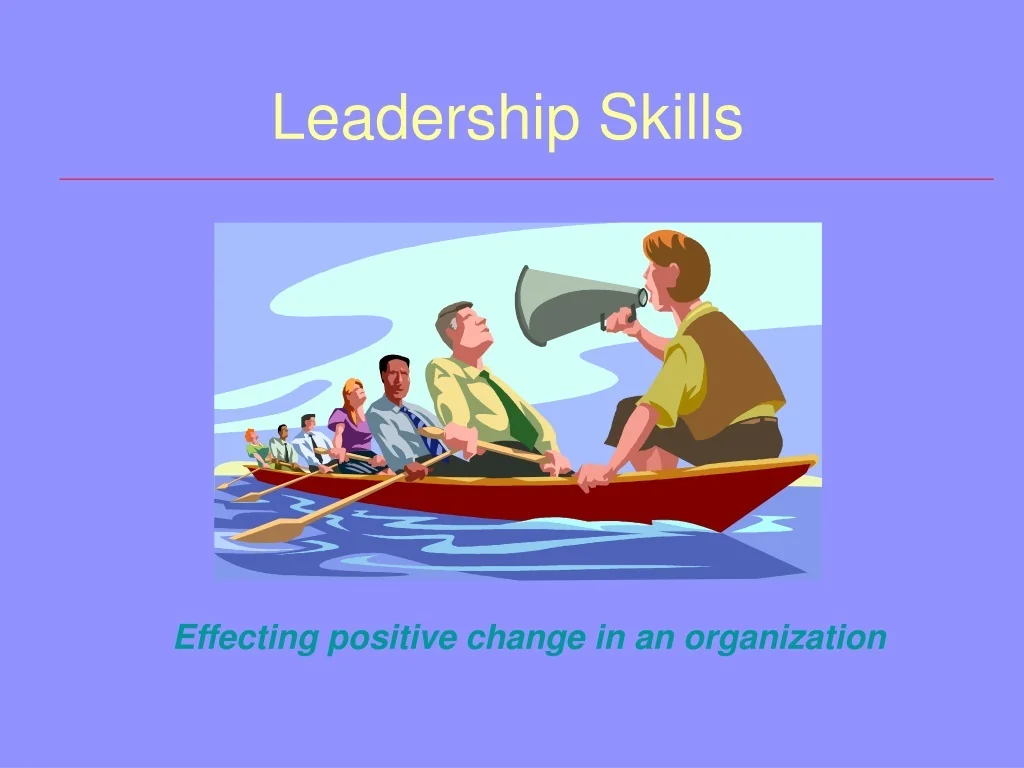
Leadership Skills Effecting positive change in an organization
“The successful organization has one major attribute that sets it apart from unsuccessful organizations: dynamic and effective leadership.” P. Hersey and K. Blanchard
Who Are Ideal Leaders? • Leaders I admire: 1. 2. 3. 4. 5. • Leaders society admires: 1. 2. 3. 4. 5.
What Are The Qualities of Ideal Leaders? • Qualities I admire: 1. 2. 3. 4. 5. • Qualities society admires: 1. 2. 3. 4. 5.
Leadership Defined • Leadership is the ability to influence others, either positively or negatively. • Positive: facilitation of task accomplishment • Negative: task accomplishment is inhibited. • Emergent vs. appointed/hired
Management vs. Leadership • Management: • control of existing operations/functions • Leadership: • strategic and visionary • The primary role of the leader: • guide the team towards a future • strategically defined goals and objectives.
Managerial and Leadership Circle
Leadership: The Experts Have Spoken • Trait • Functional • Situational
Trait Theory • Genetics, Mother Nature alone, is responsible for leadership qualities
Functional Theory • Task & Relationship • Leader emerges depending upon needs of the group
Task Leadership • Keeps the members on-task. • Initiating • Coordinating • Summarizing • Elaborating on ideas
Maintenance/Process Leadership • Tension release • Gate keeping • Encouraging • Mediating
Situational Leadership Styles • Adaptation of leadership style • Accurate assessment of the situation • React appropriately.
True leaders recognize that teams: • inhabited by humans • learned behaviors • capacity for risk-taking • linked to internal controls • …can be frustrating, stressful, and even unstable when initiative, creativity, and productivity are being expressed by team members.
Group Exercise • Split into three equal teams • The team process is important to this exercise, so everyone must participate. • Follow the instructions of your leader carefully. • Using the provided Tinker Toy sets, your team will have five minutes to build something that works…does something…has a purpose.
Leadership Styles • Autocratic/controller • Laissez-faire • Democratic leadership • Kuhnert and Lewis’s Transformational Leadership Theory • Type X The Performer • Type Y The Transformer
Autocratic/Controller Leader • ALL controlling • ensures predictable results. • Individual assignments limited, specific in nature • Team needs secondary • Responsibility not shared. • Decisions? Leader only. • Motivation= fear/intimidation • Highly productive team • BUT when leader is away, no work occurs • Sabotage • Member reaction = aggressive, or apathetic • Generals/Admirals • Size of group
Laissez-faire Leader • Minimum/No of leader participation • Supplies/materials only when requested • Infrequent, spontaneous comments on member activities • No attempt to regulate events • Often uses “hallway delegation” to assign tasks • Teams less satisfied (leader & product)
Democratic Leader • All participants have equal voice. • Information is freely shared. • Authority is delegated • Responsibility is shared by all members. • Assignments are complex • Feeling of contribution • Work occurs at all times • Teams report more satisfaction • Best in small group situation
Situational Leadership Styles • Which style appropriate? • New employee • 10 year employee • Absentee problem • Product development • Product release
Kuhnert and Lewis’s Transformational Leadership Theory Type X - “The Performer” –A “transactional” leader Type Y- “The Transformer” –A risk taker
Transactional: Reactive leadership that responds to problems in a punitive manner Transformational: Proactive Charismatic leadership that inspires exceptional performance Transactional vs. Transformational Leadership Styles
Type X Leader • A leader who does not trust team members to work and is unconcerned with the personal achievement of team members. • Does ALL of the work • No confidence in the ability of the group. • group failure to perform = no promotion/bad grade • group lacks confidence • reactive leadership= punitive • Emergency situations require performers
Type Y Leader • Transformational leaders: • risk takers • display trust in team members • concerned with member achievement. • Proactive-not reactive • Charismatic leadership • inspires exceptional performance
Meyers & Briggs Personality Profile • Which profile fits the visionary leader?
Does Leadership Style Really Make a Difference? • Superman-style outdated • one person saving the day • Today’s leader • leads a team • decisions are made collectively • common good of the organization key
Key Role for the Leader The key role for the leader • setting the context • Incorporation of organization’s strategic goals and objectives into all aspects of the daily work, and team activities.
Leadership Exercises defining the difference • leadership and authority • technical and adaptive work.
Authority • The proper use of authority = adapting to situation • decisions need know-how • beyond the issue of technical knowledge • wisdom to adapt and meet the challenge • A degree of power and influence over others • goals and objectives • Authority impacts technical and adaptive work environments
Authority and Trust • The proper use of authority requires: • Consistency • Congruity: walking the talk • Reliability • Integrity