User Datagram Protocol (UDP)
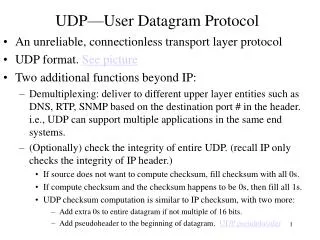
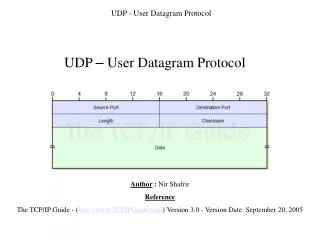
User Datagram Protocol (UDP) is a transport protocol that facilitates end-to-end communication between applications. Unlike TCP, UDP lacks connection, ensuring messages are sent without establishing a connection. It is message-oriented and each UDP message fits within an IP datagram. Renowned for its "best-effort" delivery, UDP messages can be lost, duplicated, or corrupted, making it suitable for applications that tolerate such issues. It supports arbitrary interactions like one-to-one and one-to-many communication, relying on UDP port numbers for application identification.

User Datagram Protocol (UDP)
E N D
Presentation Transcript
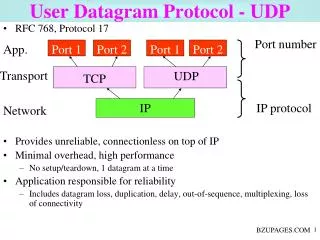
User Datagram Protocol (UDP) • IP headers cannot identify application programs running a computer • UDP is an end-to-end or transport protocol that allows an application program to serve as the end-point of communication
UDP Characteristics • End-to-end • Connectionless • Message-oriented • Each UDP message must fit within one IP datagram • Best-effort • UDP message can be lost, duplicated, or corrupted • Suitable for applications that can tolerate delivery errors • Arbitrary interaction • One-to-one, one-to-many (IP multicast/broadcast), many-to-one • Operating system independent • Relies on UDP port numbers to identify application