Essential Guide to Crafting a Professional Resume
190 likes | 317 Vues
This comprehensive guide outlines the importance and essential elements of a well-crafted resume. A resume is not just a list of jobs; it serves as a marketing tool designed to secure interviews, showcasing your qualifications in a neat, organized, and professional manner. It includes key sections such as your contact information, objective statement, education, experience, honors, and professional affiliations. Learn best practices for writing resumes, including action verbs and concise language, while avoiding common pitfalls like personal details. Aim for clarity and maximum impact to make your resume stand out.


Essential Guide to Crafting a Professional Resume
E N D
Presentation Transcript
Why do you need a resume? • A marketing tool • To obtain an interview, not a job • Requirement of many organizations
Resume- hidden messages Resume You • Neat • Well-organized • Error free • Professional appearance • Neat • Well-organized • Attention to detail • Careful & Competent
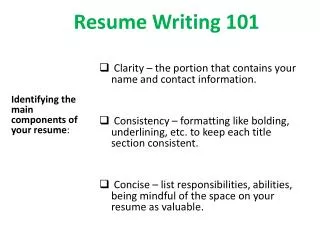
The Header • What should be included? • Name • Permanent and present address • E-mail address • Telephone number • Where should contact information go? • Top of the page
Objective Statement • Purpose • Communicate the type of position you are interested in • Examples • Management trainee position with a specialty retailer. • Technical sales with an energy related industry in the Southwest. Long range goals of regional sales management. • To obtain a position as field service representative with XYZ Software Corporation.
Education • Name of Institution • Include city and state if not part of the title • Name of your degree and major • Bachelor of _________ in ___________ • Bachelor of Science in Business Administration: Accounting • List degrees in reverse chronological order • Most recent degree is listed first
Education • Date or expected date of graduation • Graduation Date: May 2014 • Expected Graduation Date: May 2015 • GPA • Major or overall at least 3.0 • Round down to the nearest tenth • 3.0 not 3.062 • GPA: 4.0, Summa Cum Laude • High School Information • Do not include after Sophomore year
Experience • Use the term "experience" • What is considered experience? • Full and part-time jobs • Self-employment • Volunteer work • Practicum, field, and cooperative education • Information to include • Job Title • Dates of employment • Company name • City & State
ListingResponsibilities • Use bullet points • Start of each line with an action verb • Present tense if currently employed • Past tense if no longer employed • Vary your choice of verbs • Tailor skills and experiences to the position for which you are applying • Be concise while providing enough detail
Honors & Awards • Order by dates • Reverse chronological • Rank order by importance to the career objective
Professional Affiliations & Activities • Order by date • Reverse chronological • Rankorder by importance to the career objective • Do not say Member of … • Emphasize your leadership roles • Spell out the organization’s name: • Do not use abbreviations or acronyms
Resume Dos • Use action verbs • Use short, concise sentences • Use #, %, $ amounts • Keep resume easy to read • Keep resume about one page
ResumeDon’ts • Do not use the pronouns such as I, me, my, etc. • Do not include references • Do not clutter your resume with nonessential information • Do not make any misrepresentations • Do not include personal information • SSN, age, sex, height, weight, marital status, photograph, etc.